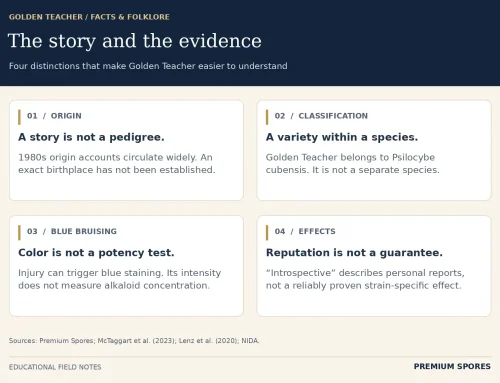
Penis Envy Mushrooms & Spores: History, Appearance, Potency, and Research
Penis Envy mushrooms have a name that gets attention and an appearance that makes it stick. Thick, pale stems support compact, rounded caps, giving this familiar Psilocybe cubensis variety a profile unlike the broad-capped mushrooms many people picture first. Its reputation, however, extends well beyond its shape.
Behind the name is a story of unusual mushroom anatomy, competing origin accounts, a much-discussed potency reputation, and microscopic reproductive cells that deserve a closer look. At Premium Spores, we find the connection between those visible mushrooms and the world of spores especially interesting. Understanding that connection makes the entire subject easier to appreciate.
This guide explores Penis Envy mushrooms and Penis Envy spores in detail: what the name means, which features distinguish the mushrooms, what research can tell us about their chemistry, and how to interpret the specimens and terminology encountered in mycology.
What Are Penis Envy Mushrooms?
Penis Envy, often shortened to PE, is a named cultivated variety of Psilocybe cubensis. It is commonly called a strain, although that word is used more loosely in mushroom catalogs and community discussions than in a laboratory strain collection. PE is not a separate mushroom species. The name identifies a lineage or group of related material within the broader species.
That distinction is useful whenever mushroom names start to pile up. Psilocybe identifies the genus, cubensis identifies the species, and Penis Envy supplies the more specific community or commercial designation. A recognizable name helps organize a conversation, but it does not replace a documented specimen history.
The visible mushroom is a fruiting body: a reproductive structure formed by a fungus. Mycelium is the network of threadlike fungal cells, called hyphae. Spores are reproductive cells, much smaller than either a mushroom or a visible patch of mycelium. These terms describe different biological structures, even when they appear together in discussions of the same variety. [1]
| Feature | Overview |
|---|---|
| Species | Psilocybe cubensis |
| Common abbreviation | PE |
| Characteristic appearance | Substantial pale stems and relatively small, rounded tan-to-caramel caps |
| Historical record | Competing accounts involving collectors, selection, and informal circulation |
| Spore characteristics | Broadly consistent with P. cubensis; ordinary microscopy does not authenticate the PE name |
| Potency reputation | Frequently described as strong; a variety name cannot establish a sample’s chemical content |
| Premium Spores listing | Penis Envy Spores (Isolated) |
Penis Envy Origins: A Famous Mushroom with an Unfinished History
Few mushroom varieties have accumulated as much storytelling as Penis Envy. Familiar versions connect it with Terence McKenna, an Amazonian collection, physician and mycology enthusiast Steven Pollock, and a later custodian known as Rich Gee. The names recur frequently; the sequence of events is less secure.
Journalist Hamilton Morris helped bring these accounts to a broad audience. His earlier reporting presented a dramatic narrative involving McKenna, Pollock, and Gee. His later podcast, The True Story of the Penis Envy Mushroom, released publicly in April 2022, revisited the subject through an extended interview. These are useful historical sources, but reporting and personal recollection should not be confused with a complete biological chain of custody. [2] [3]
A careful history therefore leaves room for uncertainty. “A story associates the lineage with an Amazonian collection” is a different claim from “every modern PE specimen has a verified connection to one original mushroom.” The first describes an account. The second would require records linking collections, transfers, and subsequent material.
Why is it called Penis Envy?
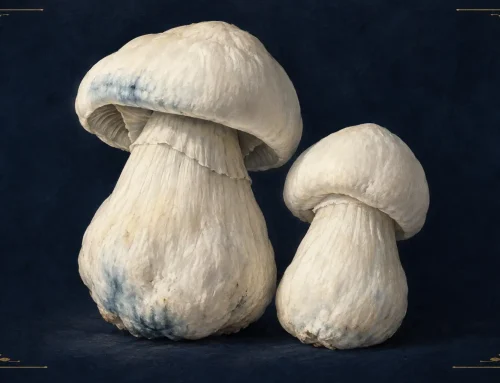
The name refers to the mushroom’s phallic appearance: a thick stem beneath a comparatively small, rounded cap. It is a visual nickname, not a formal taxonomic description. The shape also explains why PE is easy to remember after seeing only a few examples.
A memorable name can outlast the paperwork behind it. Once a label becomes familiar, it circulates through conversations, photographs, and collections. Over time, confidence in the name can become stronger than the surviving documentation. That does not make the mushroom uninteresting; it makes provenance an important part of understanding it.
Species history and variety history are different
The natural history of P. cubensis is broader than the story of Penis Envy. Species descriptions associate the fungus with dung and disturbed grassy environments in tropical and subtropical regions. Those ecological associations describe P. cubensis, not a verified birthplace for the modern PE lineage. Likewise, older cultural traditions involving psychoactive mushrooms should not automatically be described as traditions involving Penis Envy specifically. [4]
What Do Penis Envy Mushrooms Look Like?
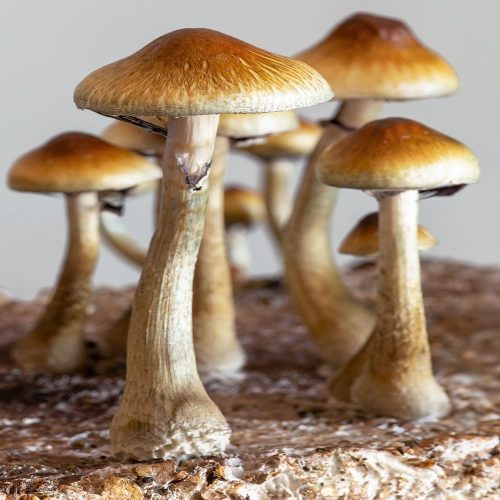
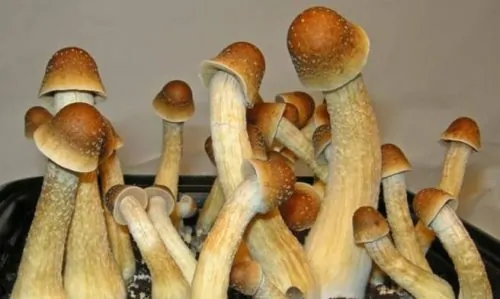
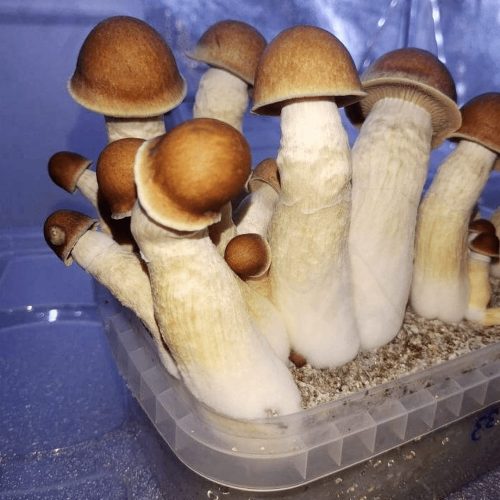
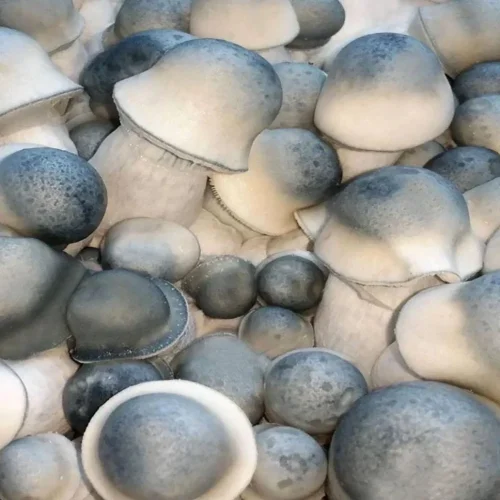
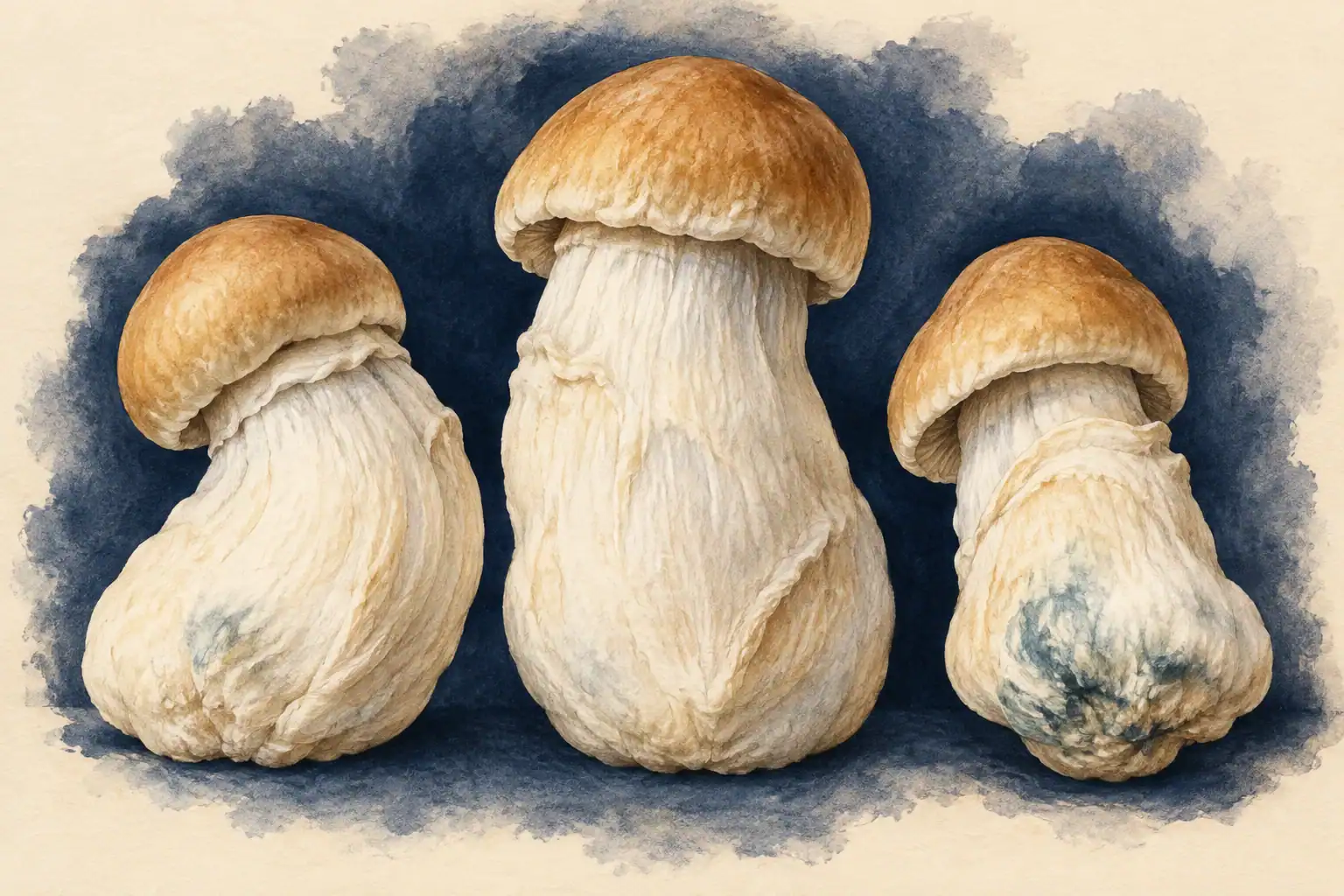
The most recognizable feature is proportion. In the familiar PE form, the stem appears unusually substantial relative to the cap. Our Penis Envy product profile describes thick, pale stems and compact caps that may remain rounded or partially closed. These are descriptive tendencies, not a requirement that every specimen look identical.
Caps: compact, rounded, and often caramel-colored
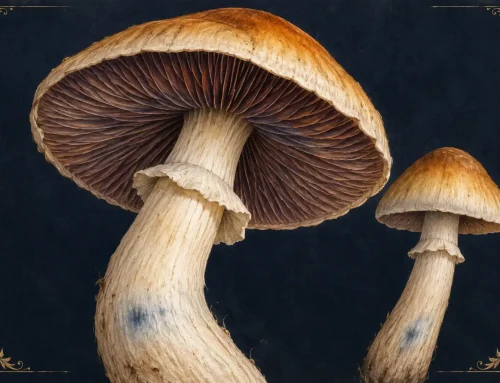
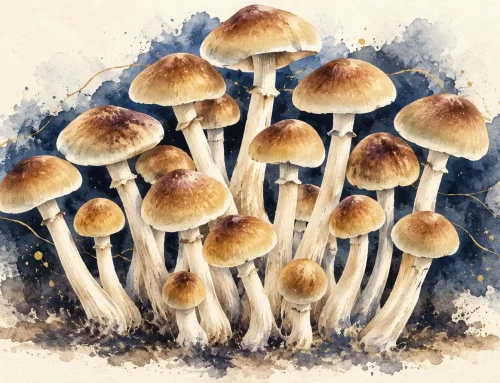
PE caps commonly appear tan, caramel, or golden brown. Their rounded outline can remain prominent instead of developing the broad, umbrella-like profile associated with many other cubensis photographs. Cap edges may sit close to the upper stem, making the transition between cap and stalk look especially compact.
Color alone is a poor way to compare pictures. A warm light can make a tan cap look golden, while a cool light can mute the same specimen. Maturity, moisture, camera exposure, and editing also affect appearance. A single photograph is best treated as a record of one specimen under one set of conditions.
Stems: pale, substantial, and sometimes irregular
The stem, or stipe, is typically white to cream in familiar PE descriptions. It can look swollen, textured, or uneven rather than smoothly cylindrical. “Thick-stemmed” describes the visible form; it does not tell us a mushroom’s measured chemical composition, exact ancestry, or tissue density.
Gills and the partial veil
Gills occupy the underside of the cap. In gilled mushrooms, the spore-bearing surface is associated with these thin structures. A partial veil protects that region during development; a remnant may remain as a ring around the stem. On a compact PE specimen, these features can be less obvious in a side-view photograph than on a mushroom with an expanded cap.
The cap’s outline, the exposed gill area, and any visible ring should therefore be described separately. A picture that hides the gills cannot establish that they are absent. Similarly, a dark patch on the stem is not automatically a spore deposit. Good descriptions identify what is actually visible and leave the rest open.
Why can Penis Envy mushrooms bruise blue?
Blue staining in Psilocybe tissue involves chemistry triggered by injury. Researchers identified an enzyme-driven sequence in P. cubensis in which psilocybin is dephosphorylated and psilocin-derived units undergo oxidative coupling, producing colored compounds. The visible reaction is more involved than simply saying that psilocybin itself is blue. [5]
Bruising does not supply a potency measurement. A deeper blue area cannot be converted into a reliable percentage of psilocybin, and blue staining is not proof that an unknown mushroom is safe. This guide describes known material; it is not a checklist for identifying wild mushrooms for consumption.
Penis Envy Potency: Reputation, Measurements, and What They Mean
Penis Envy is widely discussed as a potent cubensis variety. Both popular health coverage and mushroom discussions repeat that reputation. The more useful question is what a particular claim rests on: personal experience, one laboratory result, a comparison of several specimens, or a properly designed study.
Is Penis Envy always stronger than other cubensis varieties?
No fixed multiplier should be assigned to every mushroom carrying the name. A controlled 2026 study compared 14 named P. cubensis strains, including Penis Envy and Albino Penis Envy. The researchers found substantial differences in tryptamine concentrations between strains and variation among individual fruiting bodies within selected strains. The findings support attention to sample variability, rather than a universal strength guarantee attached to a label. [6]
That distinction matters when reading “twice as strong” or “the strongest mushroom.” Stronger than which sample? Measured by psilocybin alone, psilocin alone, or a defined total? Was the comparison made on the same moisture basis and with the same analytical method? Without those details, the apparent precision of the claim can exceed the evidence.
Why laboratory percentages need context
Research on authenticated Psilocybe specimens has documented inconsistent identifications and substantial chemical variation. A study of dried mushroom material from Japan also found differing psilocybin and psilocin concentrations between the sampled mushrooms and their parts. Neither finding supports treating all mushrooms with the same name as chemically interchangeable. [7] [8]
When evaluating a result, look for the specimen identification, what was measured, the unit, the sample date, and whether the report represents one item or a combined sample. Those details answer different questions. An average summarizes a group; it does not establish that every member of the group equals the average.
Penis Envy’s reputation can explain why people are curious. A chemical measurement is needed to describe the composition of a particular tested sample.
How psilocybin relates to reported effects
The body converts psilocybin into psilocin, a psychoactive compound that acts on serotonin signaling. Experiences can include changes in perception, emotion, thinking, and the sense of time. They can also involve nausea, confusion, panic, and impaired coordination. The DEA’s overview describes both physical and psychological adverse effects. [9]
Descriptions such as “more visual,” “more spiritual,” or “more introspective” are common in personal accounts. They do not establish a reproducible Penis Envy-specific psychological effect. A vivid story about an experience is evidence of what that person reported, not a promise about what another person would experience.
What does clinical research establish?
Researchers are investigating psilocybin for conditions including depression and alcohol use disorder. The National Center for Complementary and Integrative Health describes promising findings alongside unresolved questions and safety concerns. Clinical studies involve screening, defined procedures, and professional support. They do not establish that Penis Envy mushrooms or spore products treat a medical condition. [10]
Potential adverse effects include anxiety, nausea, increased blood pressure, and serious psychological distress. Certain psychiatric conditions can make use especially concerning. Medication interactions also require clinical attention. A mushroom profile cannot assess an individual’s suitability for psychedelic treatment, and a spore product should never be presented as a substitute for care.
Penis Envy Spores: Color, Shape, Size, and Structure
The mushroom’s unusual outline makes PE recognizable at a glance. Its spores require a different kind of attention. Penis Envy spores are microscopic reproductive cells associated with material identified as the PE lineage. Their appearance should be interpreted within the broader biology of P. cubensis.
There is no reason to expect a spore to resemble the mature mushroom. A thick stem does not imply a thick-shaped spore, and a caramel cap does not imply caramel-colored reproductive cells. Mushroom anatomy and spore morphology operate at different scales.
What color are Penis Envy spores?
Typical pigmented P. cubensis spore deposits are dark, often described as purplish brown to almost black. Individual spores under transmitted light can appear brown. The Catalogue of Fungi of Colombia records a black spore print and purplish-brown spores in a prepared mount. These descriptions refer to different viewing conditions, so they need not conflict. [4]
A deposit contains many overlapping spores. A microscopic view may show individual cells with light passing through them. Comparing those appearances is like comparing a stack of tinted sheets with one sheet held against a light: concentration and illumination change the visual impression.
Shape, surface, and the germ pore
Species descriptions include ellipsoid to somewhat angular spore outlines, a smooth surface, and a conspicuous germ pore. Ellipsoid means broadly oval in three dimensions; the outline can change with viewing angle. The germ pore is a specialized region in the wall associated with germ-tube emergence. Ultrastructural research on dormant P. cubensis spores described multiple wall layers and the germ pore. [11]
These features are useful descriptive observations. They are not a microscopic signature proving that a specimen is Penis Envy. A spore can fit a species-level description without revealing the commercial name attached to its source.
How large are Penis Envy spores?
Spore dimensions are expressed in micrometers, written µm. One micrometer is one-thousandth of a millimeter. Published measurements vary with the material and method, and a species-level reference range should not be advertised as an exact specification for every PE specimen.
For context, Tsujikawa and colleagues reported spores measuring 10.2–16.5 µm long by 5.9–10.0 µm wide in material described as P. cubensis. This was not a Penis Envy-specific measurement study, and the paper discussed difficulty distinguishing closely similar material. The range provides background, not a PE authentication test. [8]
What makes a useful microscopic observation?
Useful observations record more than “oval and dark.” Note the source label, date, magnification, mounting medium, and whether measurements were calibrated. An ocular scale must be compared with a stage micrometer before its divisions can be translated into meaningful dimensions. Michael Kuo’s microscopy guide explains the role of calibration and suitable optics. [12]
Looking at several separate spores helps avoid treating one unusual outline as typical. Keep observation distinct from interpretation: “the visible spores have smooth outlines” describes a view; “this proves an exact lineage” goes much further. Good recordkeeping preserves that distinction for future comparisons.
| Observation | Useful information | Limit |
|---|---|---|
| Pigmentation | Color under the stated viewing conditions | Does not establish potency |
| Outline and wall | Visible morphological features | Does not independently prove the PE name |
| Calibrated dimensions | Size of the spores actually measured | Does not define every specimen in the lineage |
| Source label | Recorded provenance and product identity | Is not itself an independent authentication test |
| Photograph | A record of a field of view | May omit scale, preparation details, or variation elsewhere on the slide |
Why Does Penis Envy Spore Production Get So Much Attention?
Penis Envy is frequently described as producing less conspicuous spore deposits than familiar, readily sporulating cubensis forms. Medical News Today also notes its reputation for limited spore production. That general description helps explain interest in PE spores, but it should not become the absolute claim that every PE mushroom is sterile or produces no spores. [13]
Three different questions are often compressed into the word “sporulation”: are spores formed, are they released, and do they create a visible deposit? Those questions are related, but they are not interchangeable. The absence of a dark, obvious deposit does not by itself establish the absence of spores.
There is also a difference between spore quantity and specimen identity. A dark suspension does not prove the label, while a light-looking suspension does not automatically establish poor quality. Comparing specimen formats requires more information than judging which container looks darkest.
Penis Envy Spore Syringes, Prints, and Isolated Specimens
The words used around spore products describe both biological material and its presentation. Keeping those two ideas separate makes product pages easier to understand.
What is a spore syringe?
A conventional spore syringe is a syringe containing spores suspended in liquid. The syringe is the container; the spores are the biological specimen. “Multispore” indicates the presence of many spores and does not inherently mean a mixture of several named mushroom varieties.
What is a spore print?
A spore print is a deposited collection of spores on a surface. It is another way of presenting reproductive material. A print’s visible darkness reflects a deposit, while a syringe distributes material in liquid. Those different presentations should not be treated as directly comparable visual measurements of quality.
What does “isolated” mean?
In mycology, an isolate refers to material separated and maintained for study. In commercial use, “isolated” can carry different meanings depending on the supplier and the actual specimen. The word alone does not identify whether a container holds spores, mycelium, or another preparation.
Spores and mycelium are biologically different. A conventional liquid culture contains living fungal tissue in liquid; it is not simply another name for a spore suspension. Also, sexually produced spores should not automatically be described as genetically identical copies of a selected parent. Selection of source material and clonality of the resulting specimen are separate questions. [1]
Premium Spores lists this product as Penis Envy Spores (Isolated). Please view our product page for the specific product description and included materials.
Penis Envy, Albino Penis Envy, and Other Familiar Names
PE-related names appear throughout mushroom discussions. Some emphasize color, others cap shape, and others a reported history of selection or crossing. These labels are useful conversation starters, but they should not be mistaken for a universally standardized catalog of verified ancestry.
Penis Envy and Albino Penis Envy
Albino Penis Envy, abbreviated APE, is a familiar pale form associated with the PE family of names. It is commonly distinguished by much lighter coloration than the tan or caramel appearance associated with conventional PE. APE and PE are not automatically interchangeable labels for the same specimen.
“Albino” on a name also should not replace an examination of actual pigmentation. A photograph can document pale tissue; explaining the biological cause of that appearance requires more evidence. Premium Spores maintains a separate Albino Penis Envy product page for readers exploring that designation.
Penis Envy Uncut and Penis Envy 6
Names such as Penis Envy Uncut and Penis Envy 6 appear in popular descriptions of PE-related varieties. Medical News Today associates Uncut with caps that remain attached to the stem and PE6 with a hybrid reported to produce more spores. These are reported naming conventions, not proof that every specimen sold under those names shares one verified genotype. [13]
Penis Envy versus Golden Teacher
Golden Teacher and Penis Envy offer a useful visual comparison within one species. Our Golden Teacher mushrooms and spores guide describes the familiar golden-to-caramel cap and more conventional cap-and-stem proportions. PE is generally discussed for its substantial stem and compact cap.
| Feature | Penis Envy | Golden Teacher |
|---|---|---|
| Species | Psilocybe cubensis | Psilocybe cubensis |
| Common visual description | Thick pale stem; compact rounded cap | Golden-to-caramel cap; more conventional proportions |
| Name association | Distinctive physical shape | Cap color and a cultural association with reflection |
| Spore interpretation | Species-level traits; provenance matters | Species-level traits; provenance matters |
| What the name cannot guarantee | Exact potency, effect, or genotype | Exact potency, effect, or genotype |
What Makes Penis Envy Interesting for Research?
PE gives readers a concrete example of how several kinds of evidence fit together. Its visible form raises questions about variation within a species. Its spores invite attention to structures that do not resemble the mushroom above them. Its history shows why documentation matters. Its potency reputation illustrates the difference between a widely repeated claim and a measurement.
Each kind of evidence has a useful role. A photograph records appearance. A calibrated microscopic observation records a structure and its dimensions. A chemical analysis describes the tested material’s composition. Provenance records explain where a specimen came from. None of these should be asked to answer every question on its own.
A practical specimen record
For an observational project, keep a simple record containing the product or collection label, supplier, receipt date, available batch information, and the purpose of the observation. Add images and measurement notes as they become available. Record any uncertainty instead of silently filling it in.
This approach makes comparisons more meaningful. “These two slides looked different” becomes more useful when you also know whether the lighting, magnification, and preparation were comparable. It also prevents a later reader from confusing a supplier’s designation with an identification independently established by the observer.
Explore Penis Envy at Premium Spores
Our Penis Envy Spores (Isolated) listing includes a 10cc BD Luer-Lock syringe, an individually wrapped sterile 16-gauge dispensing needle, an alcohol prep pad, and a microscopy instruction guide. The page provides the current product details and intended research use.
For a broader introduction to the subject, visit our guide to psilocybin mushroom spores. Together, these resources connect a familiar variety name with the wider questions that make mycology worth exploring.
Penis Envy Mushroom and Spore FAQs
Are Penis Envy mushrooms a separate species?
No. Penis Envy is a named variety within Psilocybe cubensis. The variety name is more specific than the species designation, but it is not a separate species classification.
Do Penis Envy spores look like tiny mushrooms?
No. Spores are microscopic cells, not miniature caps and stems. Their features are described through pigmentation, outline, wall structure, dimensions, and other observations.
Can you confirm Penis Envy from a spore photograph?
A photograph alone cannot authenticate the PE designation. Similar microscopic features occur across cubensis material, and an image may not contain the scale, provenance, or preparation details needed even for a careful comparison.
Does every Penis Envy mushroom produce no spores?
No universal claim of that kind is justified. PE is associated with limited or less obvious spore deposits, but formation, release, and visibility are different questions, and named material can vary.
Are Penis Envy spores more potent than other spores?
“Potency” in this context concerns psychoactive compounds in mushroom material. It is not a useful way to rank spore specimens. A spore’s visible size, color, or concentration cannot establish the chemical composition of a mushroom.
Is a darker syringe a better specimen?
Darkness alone cannot establish identity, cleanliness, or suitability for a particular observation. The specimen description and supporting information are more useful than a simple visual comparison of containers.
Does isolated mean every spore is genetically identical?
No. A commercial “isolated” label should not automatically be interpreted as proof of clonality. The actual biological material and the supplier’s description must be considered.
Is Albino Penis Envy the same as regular Penis Envy?
They are related naming categories within cubensis discussions, but they are not interchangeable product identities. APE is commonly associated with pale coloration; use the exact designation recorded for a specimen.
Are Penis Envy mushrooms and spores legally interchangeable?
No. A statement about one material should not be applied automatically to another. Psilocybin and psilocin are federally controlled substances in the United States, and laws can distinguish materials and activities differently. Check current rules for your location and the actual specimen involved; an online listing does not establish blanket permission. [14]
Where can I find the Premium Spores Penis Envy listing?
Visit Penis Envy Spores (Isolated) for the current product description. Our spores are offered for lawful microscopy and taxonomy research, not consumption or cultivation.
Sources and Further Reading
References distinguish mushroom biology, chemical measurements, health information, and historical reporting. Species-level findings are not presented as tests of Premium Spores products.
- OpenStax. Biology 2e: Characteristics of Fungi. Background on fungal structures and reproduction.
- Hamilton Morris. A Nice, Thick, Uncut 12-inch Shroom. Earlier historical reporting; not treated as a verified lineage record.
- Hamilton Morris. The True Story of the Penis Envy Mushroom. Podcast, April 1, 2022.
- Catalogue of Fungi of Colombia / Kew. Psilocybe cubensis species description.
- Lenz et al. (2020). Injury-Triggered Blueing Reactions of Psilocybe “Magic” Mushrooms. Angewandte Chemie International Edition.
- Sharchaton et al. (2026). Surprising Variability in Tryptamine Profiles of Psilocybe cubensis Fruiting Bodies: Inter- and Intra-Strain Differences Across 14 Strains Cultivated Under Controlled Conditions. Journal of Fungi.
- Bradshaw et al. (2022). DNA Authentication and Chemical Analysis of Psilocybe Mushrooms Reveal Widespread Misdeterminations in Fungaria and Inconsistencies in Metabolites. Applied and Environmental Microbiology.
- Tsujikawa et al. (2003). Morphological and chemical analysis of magic mushrooms in Japan. Forensic Science International. Species-level measurement context, not a Penis Envy product specification.
- U.S. Drug Enforcement Administration. Psilocybin fact sheet.
- National Center for Complementary and Integrative Health. Psilocybin for Mental Health and Addiction: What You Need To Know.
- (1987). Ultrastructure and Cytochemistry of Dormant Basidiospores of Psilocybe cubensis. Mycologia.
- Michael Kuo, MushroomExpert.com. Using a Microscope to Study Mushrooms.
- Medical News Today. What are penis envy mushrooms? General overview; popular descriptions are distinguished from measured findings.
- U.S. Drug Enforcement Administration. Drug Fact Sheet: Psilocybin. Federal scheduling background.
Educational purposes only. This article is not medical advice or a guide to identifying wild mushrooms for consumption. Premium Spores specimens are intended for lawful microscopy and taxonomy research, not consumption or cultivation. Follow applicable laws.