
Psilocybe Cubensis Strains: A Guide to 20+ Cubensis Mushroom Varieties
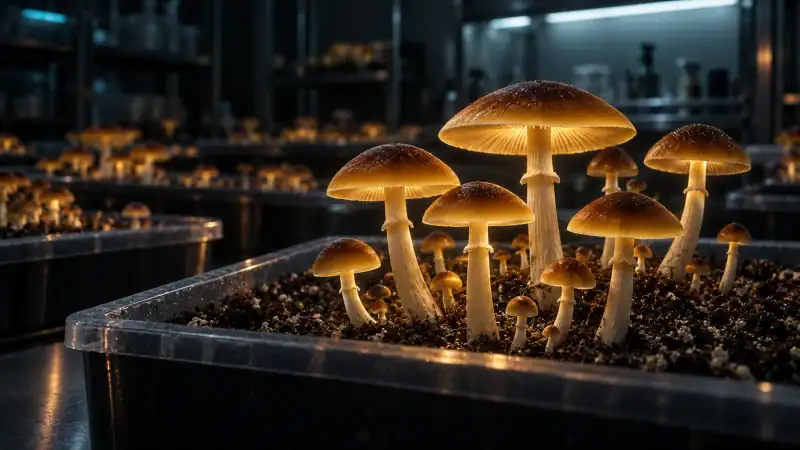
Psilocybe cubensis is a single species, but collectors and researchers use dozens of variety names, also called strains, to keep track of different lines. Some trace back to specimens collected in a particular region of the world; others came from isolations or crosses in a mycology lab. In this guide, we cover a selection of the strains we carry, including their reported origins, appearance, and microscopy notes. Please note that although researchers sometimes use the broader phrase psilocybin spores, the varieties in this guide are all named lines of the Psilocybe cubensis species. The spores themselves do not contain psilocybin; the phrase refers to spores produced by mushroom species that may contain psilocybin after development.
There is no official count of cubensis varieties. You may see estimates ranging from around 60 established varieties to well over 100 names in circulation. Some of those names likely refer to closely related lines. We use “strain” and “variety” interchangeably here, though neither is a formal scientific classification.
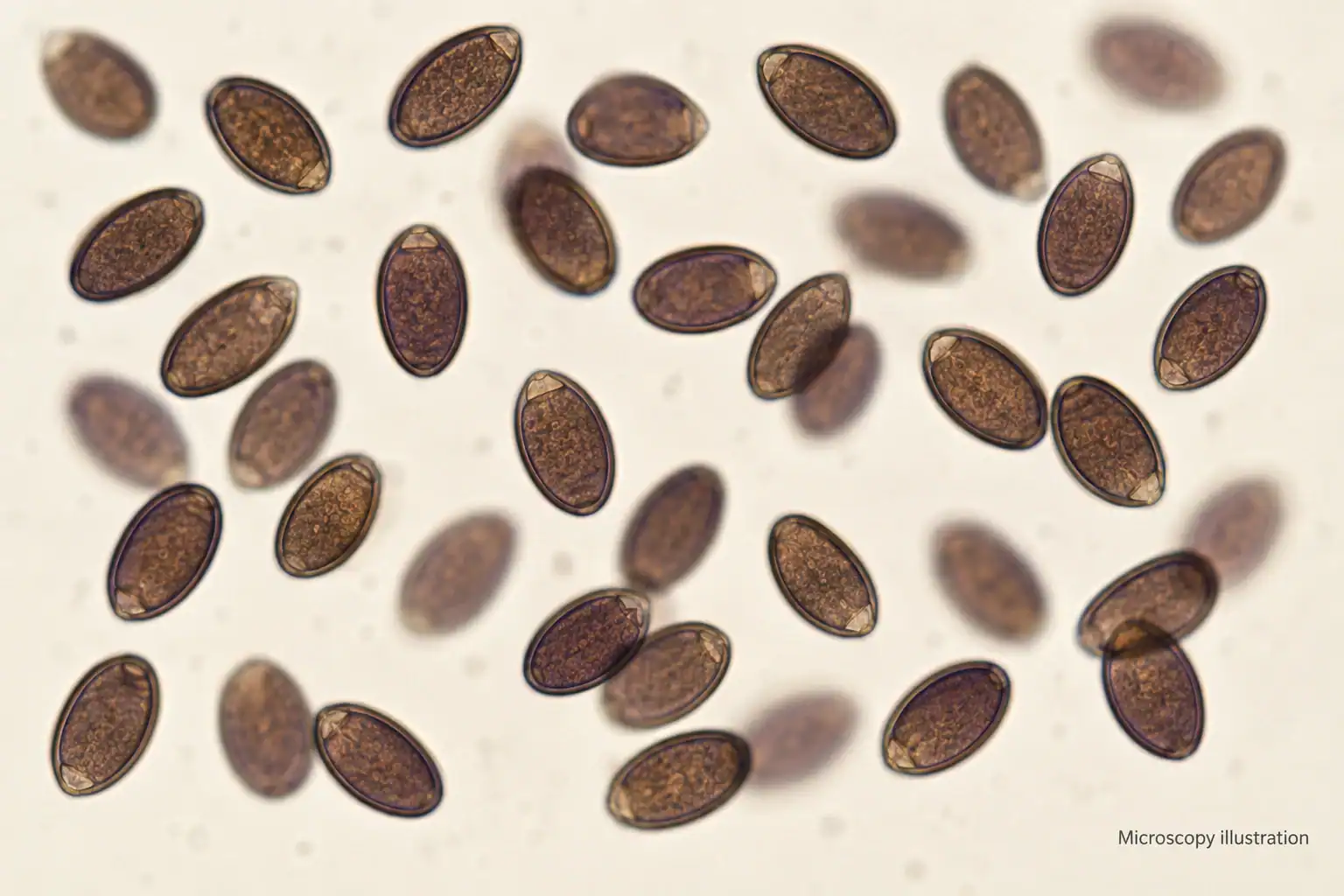
Under the microscope, spores from different cubensis strains can be hard to tell apart. They are typically sub-ellipsoid, roughly 11.5–17.3 × 8–11.5 µm, with dark purple-brown to purplish-black prints. The more useful distinctions are a strain’s documented lineage and the appearance of mature specimens. That makes clear sourcing especially helpful when choosing a syringe for your collection.
How mushroom strains get their start
The “Type” column in the table below uses a few terms you’ll see across the cubensis world:
- Landrace: a strain descended from wild specimens collected in one place and usually named for it, such as Cambodian, Huautla or Mazatapec.
- Isolation (isolate): a line narrowed down to a single selected genetic individual so its traits stay consistent. Isolated spore syringes come from these lines.
- Cross (hybrid): a strain created by combining the genetics of two existing strains, such as the reported Tidal Wave × Blue Meanie parentage of Bluey Vuitton.
- Mutation: a line that began with a specimen showing an unusual spontaneous trait. Penis Envy’s dense, closed caps and the missing pigment in albino strains are examples.
- Classic cubensis: long-circulating commercial strains whose exact origins were never documented.
Jump to a strain
| Strain | Type | Reported origin | Shop |
|---|---|---|---|
| Golden Teacher | Classic cubensis | Unknown; often credited to the U.S. Southeast | Shop Golden Teacher spores |
| Penis Envy | Mutation | Amazon; linked to McKenna and Pollock, 1970s | Shop Penis Envy spores |
| Albino Penis Envy | Albino mutation | Hobbyist breeding | Shop Albino Penis Envy spores |
| Purple Mystic | Isolation | Plant City, Florida | Shop Purple Mystic spores |
| McKennaii | Unknown | Unknown; named for Terence McKenna | Shop McKennaii spores |
| Brazil / Corumba | Landrace | Brazil | Shop Brazil / Corumba spores |
| Entheogen Explosion | Cross (reported) | Unknown | Shop Entheogen Explosion spores |
| B+ | Classic cubensis | U.S.; attributed to "Mr. G" | Shop B+ spores |
| Jedi Mind F*ck | Unknown | Unknown | Shop Jedi Mind F*ck spores |
| Treasure Coast | Landrace (reported) | Treasure Coast, Florida | Shop Treasure Coast spores |
| Melmac | Isolation (PE line) | U.S. spore trade | Shop Melmac spores |
| Luminous Lucies | Isolation | Unknown | Shop Luminous Lucies spores |
| PES Hawaiian / Maui Platinum | Isolation | Pacific Exotic Spora, Hawaii | Shop PES Hawaiian / Maui Platinum spores |
| Cambodian | Landrace | Cambodia (near Angkor Wat) | Shop Cambodian spores |
| Thai Elephant Dung | Landrace | Thailand | Shop Thai Elephant Dung spores |
| Bluey Vuitton | Cross | U.S. hobbyist breeding | Shop Bluey Vuitton spores |
| Mexi Cube | Classic cubensis | Oaxaca, Mexico (reported) | Shop Mexi Cube spores |
| Mazatapec | Landrace | Mazatec region, Oaxaca, Mexico | Shop Mazatapec spores |
| Blue Meanie | Classic cubensis | U.S. spore trade | Shop Blue Meanie spores |
| Huautla | Landrace | Huautla de Jiménez, Oaxaca, Mexico | Shop Huautla spores |
| Illusion Weaver | Isolation / cross | U.S. hobbyist breeding | Shop Illusion Weaver spores |
| Lizard King | Isolation | U.S. Gulf Coast | Shop Lizard King spores |
No strains match that search.
Our most popular strains

Golden Teacher
Golden Teacher is the most searched cubensis strain and a common first choice for new microscopists. It reportedly entered the U.S. spore trade decades ago, but its exact origin was never documented. Mature specimens have broad golden-brown caps, often flecked with lighter yellow, on long pale stems.
Read the full Golden Teacher strain guide · Shop Golden Teacher spores · Shop isolated Golden Teacher
Penis Envy
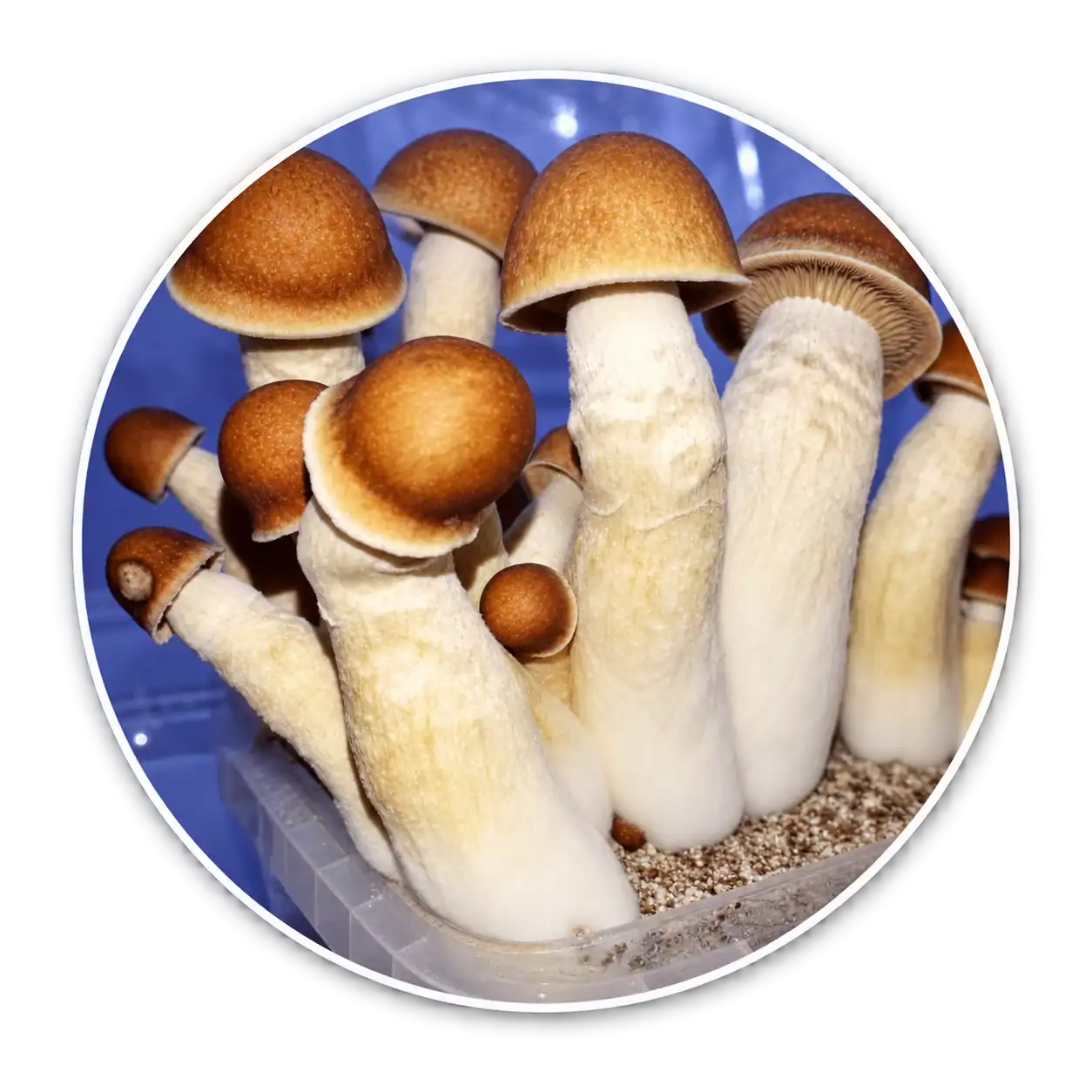
Penis Envy is the best-known cubensis mutation. Its lineage is usually traced to Amazonian material from the 1970s, credited variously to Terence McKenna and Steven Pollock. Specimens are dense and thick-stemmed, with caps that often stay closed. That trait means low spore production, which makes clean PE prints and syringes harder to source.
Read the full Penis Envy guide · Shop Penis Envy spores · Shop PE6 spores
Albino Penis Envy
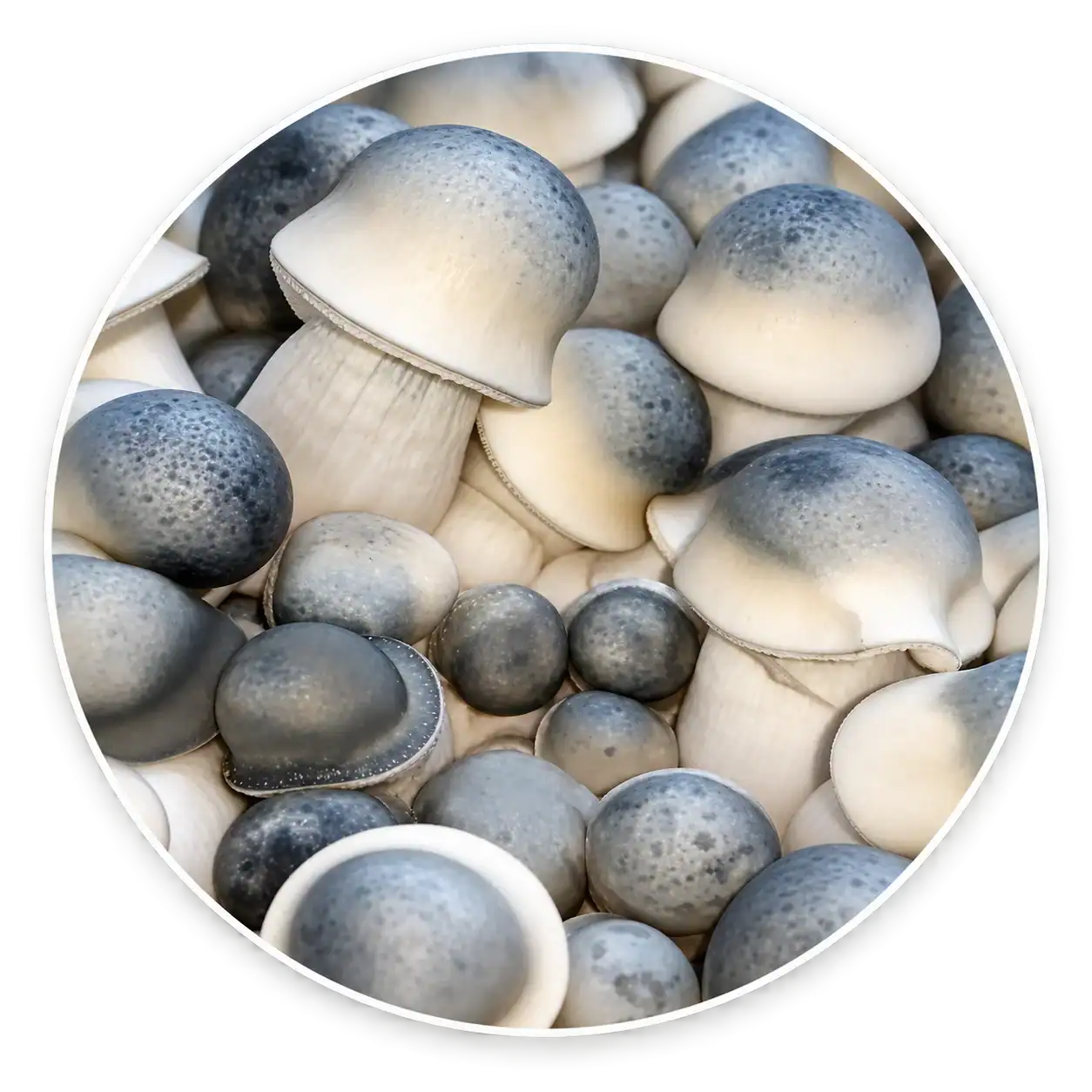
Albino Penis Envy (APE) keeps the dense PE shape but lacks most of its pigment, giving pale white to cream specimens. It came out of hobbyist breeding, with some accounts calling it a cross of PF Albino and Penis Envy. Like PE, it sporulates poorly, so verified APE spores are among the scarcer cubensis offerings.
Read the full Albino Penis Envy guide · Shop Albino Penis Envy spores
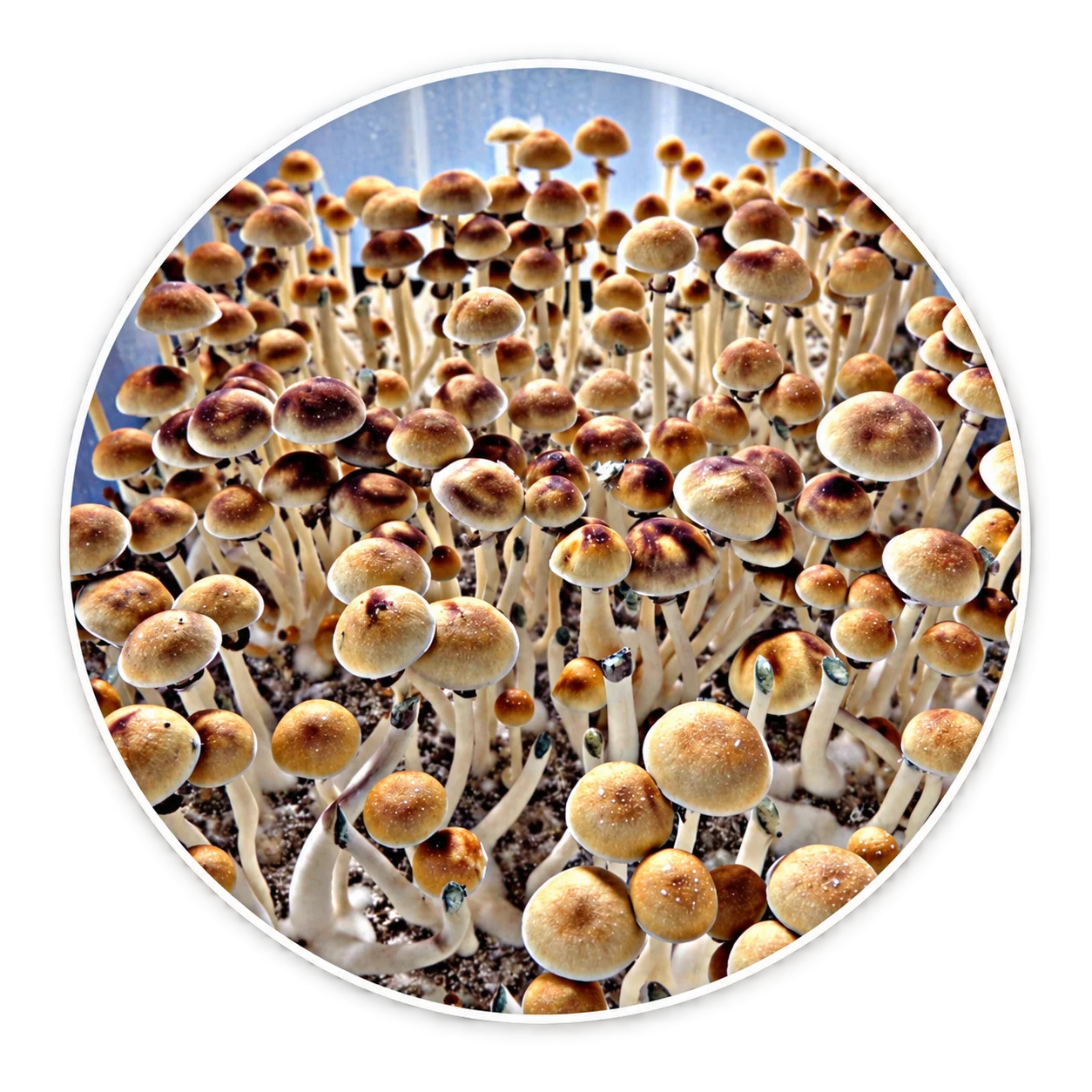
Purple Mystic
Purple Mystic is a Florida strain, reportedly isolated from material found near Plant City. It is named for the purple tones some collectors note in its caps and stems. It is a newer and less common strain, which makes it a good comparison specimen alongside the classics.
Read the full Purple Mystic strain guide · Shop Purple Mystic spores · Shop isolated Purple Mystic
Rising strains
Bluey Vuitton
Bluey Vuitton is a newer designer strain from hobbyist breeders, and its parentage is disputed. One common account calls it a Tidal Wave × Blue Meanie cross. The name plays on a luxury fashion brand. Specimens are known for strong blue bruising on light handling and caramel caps that darken to rust-brown.
Jedi Mind F*ck
Jedi Mind F*ck (JMF) is a popular name with little documented history. It may be an isolation or renamed line from an established spore bank, and it is often grouped with the Golden Teacher family because of their visual similarity. Specimens show dense, sturdy stems and broad caps. Spores are dark purplish-brown to violet-brown and elliptical, around 11–14 × 7–9 µm.
Shop isolated Jedi Mind F*ck spores
McKennaii
McKennaii is named in honor of ethnobotanist Terence McKenna. Beyond the name, its origin is undocumented. Some accounts link it to the Penis Envy family, but no reliable breeding record exists. Specimens typically show caramel to golden caps on thick, dense white stems. Spores are dark purplish-brown with the uniform sub-ellipsoid shape typical of cubensis.
McKennaii is a well-known name that gets steady search interest, so it is a good addition to a reference collection alongside Golden Teacher and B+.
Brazil / Corumba
Brazil, sometimes sold as Corumba, is a Brazilian landrace. The Corumba name reportedly points to Corumbá, a city in western Brazil near the Bolivian border. Mature specimens are known for thick stems and large, heavy caps. Spores are purple-brown and ellipsoid.
As a documented landrace, it is useful for comparing wild-collected material against isolations and designer crosses.
Shop Brazil / Corumba spores · Brazil / Corumba spore print
B+
B+ is one of the most widely distributed cubensis strains in the U.S. It is attributed to a supplier known as “Mr. G,” who originally marketed it as a cubensis × azurescens hybrid. Today it is generally treated as a pure cubensis. Mature specimens are large, with broad caramel caps that lighten toward the edges.
Shop B+ spores · Shop isolated B+ · B+ spore print
Entheogen Explosion
Entheogen Explosion’s origins are unclear. It is generally described as a hybrid drawn from several established cubensis strains. Under magnification its spores are reported to run slightly darker than most cubensis, around 12 × 8 µm, deep chestnut to dark purple-brown, with high spore density. That density makes it a practical strain for practicing slide preparation.
Shop Entheogen Explosion spores · Shop isolated Entheogen Explosion
More cubensis strain profiles
Treasure Coast
Treasure Coast is a Florida strain named for the Treasure Coast, the stretch of Atlantic shoreline around Vero Beach and Stuart. It is usually described as a wild-collected landrace, though some accounts credit “Mr. G” with isolating it. Specimens are medium-sized, with light caramel to golden caps, often darker at the center, on slender stems.
Melmac
Melmac is a Penis Envy isolation that spread through the U.S. spore trade in the late 2010s. Its name nods to the home planet of ALF, the 1980s TV alien. It shares PE’s dense, thick-stemmed build and caramel caps that often stay partly closed. Like PE, it sporulates poorly, so good Melmac prints are relatively scarce.
Shop isolated Melmac spores · Melmac spore swabs
Luminous Lucies
Luminous Lucies (also sold as Luminous Lucy) is an isolated cubensis line with little documented history. It is valued for its visual appeal both as a specimen and under the microscope. Spores are dark purple-brown and ellipsoid.
Shop isolated Luminous Lucies spores
PES Hawaiian / Maui Platinum
PES Hawaiian takes its name from Pacific Exotic Spora (PES), the spore company founded by Steven Pollock and based in Hawaii. PES named this isolation after its home state. We carry it under the Maui Platinum name as well.
Shop Maui Platinum (PES Hawaiian) spores · Shop isolated Maui Platinum · PES Hawaiian spore print
Cambodian
Cambodian is a landrace collected in the early 1990s by mycologist John Allen. The original sample was reportedly found near the temple complex of Angkor Wat. It is one of the better-documented wild origins among common cubensis strains, which makes it a useful reference specimen.
Thai Elephant Dung
Thai Elephant Dung is a Thai landrace, also credited to John Allen. As the name says, the original specimens were reportedly found growing on elephant dung. It is a good example of cubensis’s natural habitat: the species is coprophilous, growing on the dung of large grazing animals.
Shop isolated Thai Elephant Dung spores
Mexi Cube
Mexi Cube is a classic Mexican cubensis line. The original sample was reportedly collected around Oaxaca, and the strain is usually attributed to “Mr. G.” Caps are orange-brown, often with a pronounced central bump (umbo).
Mazatapec
Mazatapec is a landrace from the Mazatec region of Oaxaca, Mexico. It is named for the Mazatec people, whose ceremonial use of psilocybin mushrooms drew worldwide attention in the 1950s. It is one of the older strains in circulation and a staple of historical collections.
Blue Meanie
Blue Meanie is a cubensis strain whose name causes confusion. It borrows a common nickname for Panaeolus cyanescens, an entirely different species also called “blue meanies.” The cubensis strain is named for its heavy blue bruising. Check which species a listing means before you buy.
Shop Blue Meanie spores · Shop isolated Blue Meanie
Huautla
Huautla is a landrace from Huautla de Jiménez, a mountain town in Oaxaca, Mexico. The town became famous in the 1950s through the curandera María Sabina and the Western researchers who visited her. That history makes Huautla a favorite among collectors who value provenance.
Illusion Weaver
Illusion Weaver is a hobbyist-era strain with disputed roots. Some sources call it a Penis Envy × B+ cross; others say it is an isolation of an older line under a new name. Specimens are described with golden, wavy caps and thick stems. The print is deep purple-brown.
Shop isolated Illusion Weaver spores
Lizard King
Lizard King was isolated by a Shroomery forum member who went by that name, reportedly from material found on the U.S. Gulf Coast. The name also nods to Jim Morrison’s famous nickname. Specimens have golden to caramel-brown caps that flatten with age and relatively thick white stems.
Shop isolated Lizard King spores
Also in our catalog
More cubensis strains we carry, with profiles coming soon: Koh Samui Super Strain, Z Strain, PES Amazonian, Tidal Wave, Albino Louisiana, Leucistic Golden Teacher, Jack Frost, Fiji, Burma, Ecuador, Florida White, Pink Buffalo, Mister Kenny and Air Force 1.
Cubensis strain FAQ
How many Psilocybe cubensis strains are there?
There is no official or fixed count of Psilocybe cubensis strains. Around 60 established varieties are widely known, and many additional names circulate among collectors and spore banks. Some trace back to wild collections, while others come from selected traits, crosses or mutations. And anyone can isolate a mutation and name it, so the number is constantly growing and many are closely related lines may be shared under different names, making an exact total very difficult to establish.
Can you tell cubensis strains apart under a microscope?
Usually you can not tell studying the spores themselves. Most cubensis spores fall in the same size and shape range, with the same dark purple-brown color and are very tiny. Strains are distinguished by lineage and by the traits of the mature specimen.
What is the difference between isolated and multispore syringes?
A multispore syringe contains spores from many genetic individuals. An isolated syringe comes from a single selected line, so specimens are more consistent. Our isolated vs. multispore guide covers the trade-offs.
Which strain is best for a first microscopy project?
Golden Teacher and B+ are usally best for beginner researchers.
Is it legal to buy mushroom spores?
Yes! Cubensis spores contain no psilocybin or psilocin, which is why they can be sold for microscopy in most U.S. states. However, a few U.S. states do restrict them. See our Legality of Mushroom Spores post for more information.
All spores sold by Premium Spores are intended for microscopy, identification and taxonomic research only. We do not provide cultivation information, and nothing on this page is advice to cultivate. Strain histories are based on published accounts and collector records, which often conflict; we note where origins are uncertain.