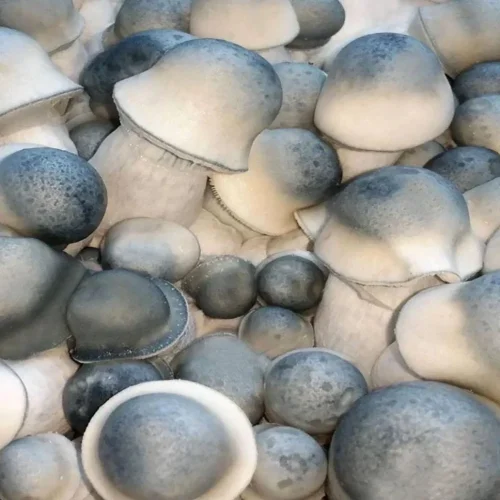
How to Collect Mushroom Spores: A Guide to Making Spore Prints
Mushrooms reproduce by releasing microscopic spores into the environment. Although individual mushroom spores are far too small to examine with the naked eye, thousands or millions of spores collected together can form a visible deposit known as a spore print.
Creating a mushroom spore print is one of the simplest ways to observe this fascinating part of fungal biology. Spore prints are commonly used by mycologists, mushroom enthusiasts, and researchers to examine characteristics such as spore color, distribution, and morphology.
In this guide, we'll explain how mushroom spores are released, how spore prints are collected, what you can learn from them, and how spores can be examined under a microscope.
If you're new to fungal biology, you may also want to visit our Premium Spores mushroom spore collection to explore different mushroom genetics available for microscopy and taxonomy research.
What Are Mushroom Spores?
Mushroom spores are microscopic reproductive cells produced by fungi. In many familiar mushroom species, spores develop on specialized structures located underneath the mushroom cap.
For gilled mushrooms, these structures are found along the thin plates known as gills. Other fungi may produce spores from pores, ridges, teeth, or other specialized surfaces.
Once mature, spores are released into the surrounding environment. Air currents, animals, water, and gravity can then carry them away from the mushroom.
A single mature mushroom may release an enormous number of spores. Although an individual spore is microscopic, a concentrated deposit of spores may appear as a visible powder ranging from white and cream to brown, rust, purple-brown, or black depending on the species.
What Is a Mushroom Spore Print?
A mushroom spore print is the visible pattern created when spores fall from a mushroom's spore-producing surface onto paper, foil, glass, or another flat surface.

Because the spores fall directly from the underside of the mushroom cap, the finished print often mirrors the arrangement of the mushroom's gills or pores. The result can look almost like a fingerprint made by the mushroom itself.
Spore prints are particularly useful because spore color can be an important characteristic when identifying mushrooms. Two mushrooms may appear remarkably similar externally while producing noticeably different spore colors.
Why Do Mycologists Collect Mushroom Spores?
There are several reasons researchers and mushroom enthusiasts collect spores.
- Mushroom identification: Spore-print color can help narrow down the possible genus or species of an unknown mushroom.
- Microscopy: Individual spores can be examined for shape, size, surface characteristics, and other microscopic features.
- Taxonomy: Spore morphology is frequently one of many characteristics used to classify fungi.
- Education: Making a spore print provides an easy way to observe the reproductive biology of mushrooms.
- Specimen documentation: Researchers may preserve prints alongside photographs and field notes when documenting mushroom specimens.
A spore print should never be used as the sole method of determining whether a wild mushroom is safe to eat. Proper mushroom identification may require examination of numerous physical and microscopic characteristics.
How to Collect Mushroom Spores With a Spore Print
Making a basic spore print requires very little equipment. The technique is frequently used when studying common edible, wild, and research mushroom species.
What You'll Need
- A mature mushroom specimen
- Clean white and dark paper, aluminum foil, or glass
- A clean cup, bowl, or container large enough to cover the mushroom cap
- A clean knife or scissors if the stem needs to be removed
- Clean tweezers or gloves if you want to minimize direct handling
Step 1: Choose a Mature Mushroom
Begin with a mature mushroom whose cap has opened sufficiently to expose the spore-producing surface underneath.
Very young mushrooms may not yet be producing mature spores, while old or damaged mushrooms may produce an incomplete print.
If the mushroom was collected outdoors for identification, photograph the entire specimen before removing the stem. Features such as the cap, stem, gills, surrounding habitat, and substrate can all provide useful identification information.
Step 2: Expose the Gills or Pores
Carefully remove the stem if necessary so that the underside of the mushroom cap can rest relatively flat against the collection surface.
For most gilled mushrooms, position the cap with the gills facing downward.
If you're examining a mushroom with pores rather than gills, position the pore surface downward instead.
Step 3: Place the Cap on the Collection Surface
Place the mushroom cap onto clean paper, aluminum foil, glass, or another nonporous surface.
When the expected spore color is unknown, one useful technique is to position part of the mushroom over a light background and part over a dark background. This makes both light-colored and dark-colored spores easier to see.
Aluminum foil is another popular choice because many different spore colors remain visible against its reflective surface.
Step 4: Cover the Mushroom Cap
Place a clean glass, bowl, or similar container over the mushroom.
Covering the cap helps protect the sample from drafts and minimizes disturbance while spores naturally fall from the mushroom.
It also helps prevent surrounding dust or debris from landing on the collection surface.
Step 5: Allow the Spores to Drop
Leave the mushroom undisturbed for several hours. Depending on the mushroom's maturity and species, a visible print may begin forming relatively quickly, while other specimens may require considerably longer.
During this period, spores released from the mushroom fall directly onto the surface beneath the cap.
Step 6: Carefully Remove the Mushroom
Lift the mushroom cap straight upward without sliding it across the surface.
If enough spores were released, you should see a pattern corresponding to the mushroom's gills or pores.
The color of this deposit is known as the mushroom's spore-print color.
What Color Are Mushroom Spores?
There is no single mushroom spore color.
Depending on the species, spore prints may appear:
- White
- Cream
- Yellow
- Pink
- Salmon
- Rust-brown
- Chocolate brown
- Purple-brown
- Dark brown
- Black
Spore color can provide an important clue when identifying an unknown mushroom. For example, two mushrooms with similarly shaped caps and gills may belong to entirely different groups if their spore prints are different colors.
Can You See Individual Mushroom Spores?
Not without magnification.
The powder visible in a spore print is actually a massive collection of microscopic spores deposited together.
Individual spores generally require a microscope to observe clearly. Under magnification, mycologists may examine characteristics including:
- Spore shape
- Spore size
- Surface texture
- Wall thickness
- Coloration
- Presence of specialized microscopic structures
These characteristics can provide additional information beyond what is visible from the mushroom itself.
Spore Prints vs. Spore Syringes
Spore prints and spore syringes contain the same basic biological material — mushroom spores — but they present those spores differently.
A spore print contains spores deposited onto a flat surface.
A spore syringe contains microscopic spores suspended in a liquid solution, making small samples easier to place onto microscope slides for examination.
Premium Spores offers a large selection of mushroom spore specimens prepared for microscopy and taxonomy research.
You can also explore our collection of isolated spore syringes and mushroom spore syringe bundles.
How Are Mushroom Spores Examined Under a Microscope?
Microscopy allows researchers to study details that cannot be seen in a spore print alone.
A small sample containing spores can be placed onto a microscope slide and examined under appropriate magnification. Depending on the mushroom species and microscope equipment being used, researchers may compare characteristics such as size, shape, pigmentation, and surface structure.
These observations are especially useful when studying mushrooms whose external characteristics are similar.
Why Spore Prints Are Useful for Mushroom Identification
Mushroom identification is rarely based on a single characteristic.
Mycologists may examine a combination of:
- Cap shape and color
- Gill or pore structure
- Stem characteristics
- Bruising or color changes
- Odor
- Habitat
- Substrate
- Spore-print color
- Microscopic spore characteristics
The spore print adds another piece to that biological puzzle.
For example, discovering that a mushroom has white spores rather than brown spores can immediately eliminate numerous possible species during identification.
Tips for Getting a Clear Mushroom Spore Print
- Use a mature specimen. Immature mushrooms may not release many spores.
- Avoid strong airflow. Fans and open windows can scatter spores before they land on the collection surface.
- Cover the cap. A glass or bowl helps protect the developing print.
- Use contrasting surfaces. A combination of light and dark backgrounds makes unknown spore colors easier to identify.
- Handle the print carefully. Spore deposits can be extremely fine and easily disturbed.
- Document the specimen. Photographs and notes about the mushroom and where it was found can be valuable during identification.
Do All Mushrooms Produce Visible Spore Prints?
No. Some mushrooms produce much heavier prints than others.
A weak or nonexistent print does not necessarily mean the mushroom lacks spores. The specimen may be immature, past its peak spore-producing stage, unusually dry, damaged, or simply a species that releases spores differently.
The anatomy of the mushroom also matters. Many familiar mushrooms release spores from gills, while others use pores, teeth, ridges, or completely different reproductive structures.
Frequently Asked Questions About Collecting Mushroom Spores
What is the easiest way to collect mushroom spores?
For many common gilled mushrooms, the easiest method is to create a spore print by placing a mature mushroom cap gill-side down on clean paper, foil, or glass and covering it while the spores naturally fall onto the surface.
How long does a mushroom spore print take?
Some mushrooms begin depositing visible spores within a few hours, while others may require longer. Spore production depends on the species, maturity, moisture level, and condition of the mushroom.
What is the best surface for collecting mushroom spores?
Paper, aluminum foil, and glass can all work well. Using both light and dark backgrounds can be especially useful when you do not already know the expected spore color.
Why are mushroom spore prints important?
Spore prints reveal the color of a mushroom's spores and provide a convenient sample for further observation. Spore color is one of many characteristics mycologists use when identifying and classifying fungi.
Are the spores in a spore print visible without a microscope?
A large collection of spores is visible as a powder-like deposit, but individual spores are microscopic and generally require magnification to study.
Can spore color identify a mushroom by itself?
No. Spore color can be an important identification clue, but it should be considered alongside the mushroom's anatomy, habitat, coloration, microscopic characteristics, and other features.
Explore Mushroom Spores for Microscopy Research
Mushroom spores provide a fascinating window into fungal reproduction and taxonomy. From the distinctive patterns created by a spore print to the microscopic structures visible under magnification, spores can reveal characteristics that are impossible to see by examining a mushroom cap alone.
Premium Spores has supplied mushroom spore specimens for microscopy and taxonomy research since 2013. Our collection includes numerous Psilocybe cubensis varieties as well as other mushroom genetics for researchers and microscopy enthusiasts.
Browse Premium Spores mushroom spore specimens →
Premium Spores products are sold for lawful microscopy and taxonomy research purposes only. Always follow applicable federal, state, and local laws.