Isolated vs. Multispore Syringes: Differences, Benefits, and Trade-Offs
Multispore or isolated? If you have been comparing mushroom spore syringes, you have probably seen both options—and wondered what the difference means for your research.
The choice starts with your purpose. Are you interested in observing a varied spore sample, or documenting material associated with a particular selected source? Both can have a place in a microscopy collection. Understanding the terminology helps you choose with a clear reason.
Here, we expand on the comparison on the Premium Spores homepage, including the positives, limitations, and practical questions worth considering before you select a syringe.
What Is a Multispore Syringe?
A multispore syringe contains many mushroom spores suspended in a liquid carrier. “Multispore” refers to the presence of multiple spores; it does not mean the syringe deliberately combines different mushroom species or named varieties.
For microscopy, the spores themselves are the subject. Researchers can document features such as shape, dimensions, pigmentation, and visible structures. A sample offers opportunities to compare observations across individual spores, although it should not be treated as a complete picture of every specimen within a species.
There is also a genetic distinction. In the sexual life cycle of basidiomycete mushrooms, meiosis contributes to the production of reproductive spores. Spores from the same mushroom are therefore not automatically genetically identical. Their shared source is different from a guarantee of a shared genotype. [2]
What Is an Isolated Spore Syringe?
Our isolated spore syringes are a single, stabilized genetic line with consistent traits, suspended in a sterile solution. Each isolated spore syringe is a liquid culture syringe that is formulated and tested to contain no psilocybin or psilocin, sold for microscopy research only. Isolated spore syringes are intended for researchers seeking a more focused reference source for documenting particular characteristics and comparing observations. [1]
The useful distinction is source selection. An isolated listing points toward a selected line rather than simply a general multispore offering. How that line was selected, maintained, and documented matters when evaluating what the designation can tell you.
Terminology can also vary between suppliers. If a syringe contains established mycelium in a nutrient liquid, its biological format is liquid culture. The word “isolated” alone does not tell you whether the contents are spores or mycelium. Check the actual product description when that distinction matters to your work.
Isolated vs. Multispore Syringes at a Glance
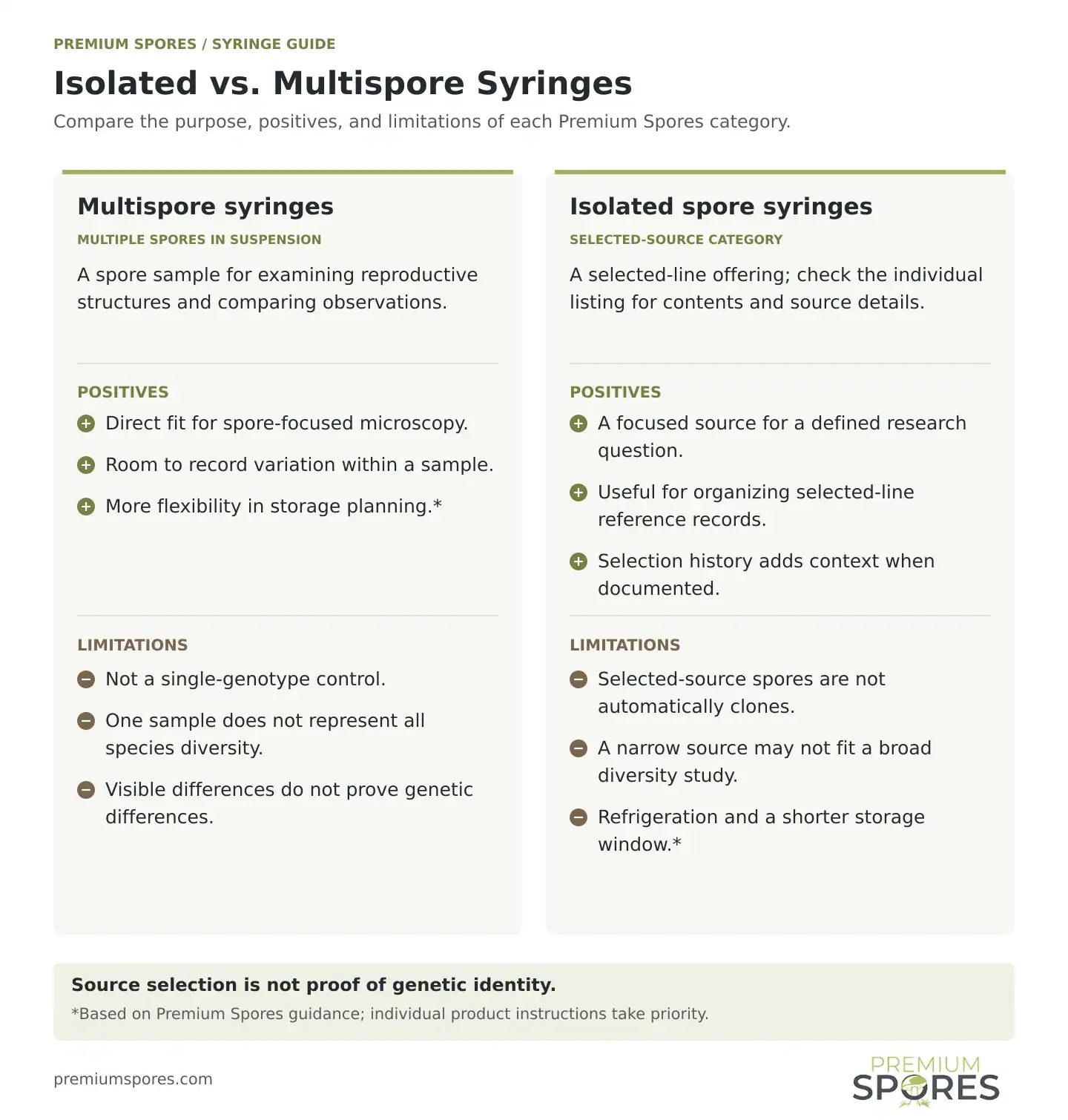
| Consideration | Multispore syringe | Isolated spore syringe |
|---|---|---|
| Source description | Multiple spores in suspension; not a promise of one genotype. | A selected-source offering, as described in the product listing. |
| Research emphasis | Observing and comparing spores within a sample. | Documenting observations associated with a selected line. |
| Main strength | A straightforward format for studying reproductive structures. | A more focused source history when selection is documented. |
| Main limitation | Does not provide a single-genotype control or represent all species diversity. | A selected source does not guarantee genetically identical spores. |
| Storage planning | Our homepage gives this category a longer planning window. | Our homepage specifies refrigeration and a shorter planning window. |
| What to verify | Species or variety, batch details, intended use, and storage instructions. | The same details, plus what “isolated” means for that specific product. |
Storage comparisons reflect Premium Spores’ category guidance. Always follow the instructions supplied with the specific product; a category label is not a universal shelf-life guarantee.
The Positives and Negatives of Multispore Syringes
Positive: A direct fit for spore-focused microscopy
When your goal is to examine spores, a spore suspension keeps the research question straightforward. You are documenting reproductive structures rather than a network of growing fungal tissue.
Positive: Room to compare observations
A multispore sample allows you to record observations across multiple spores. For a research notebook, that could mean comparing measurements, noting the range you observe, and keeping representative images under consistent viewing conditions.
Positive: More flexibility in storage planning
Our homepage describes a longer storage window for multispore syringes than for our isolated category. That may be useful when organizing a collection or scheduling microscopy sessions over time. Follow the product’s own instructions instead of applying one storage rule to every syringe.
Limitation: Variation is not the same as genetic verification
Differences you see under a microscope do not establish how genetically different two spores are. Likewise, similar-looking spores are not proof of genetic identity. A visual record is valuable, but it answers a different question from genetic testing.
Limitation: One sample has boundaries
A syringe represents the material in that sample. It does not automatically capture the full natural range of a species, establish a commercial variety’s identity, or provide a controlled single-genotype reference.
The Positives and Negatives of Isolated Spore Syringes
Positive: A selected source can give a study a clearer focus
If your question concerns a particular selected line, a corresponding isolated listing may be a more relevant starting point than a general offering. The advantage is strongest when the source and selection history are documented.
Positive: Useful organization for reference collections
A selected-source label can help organize a collection around named lines and specific research questions. Keep the label, batch information, purchase record, and your observations together so you can distinguish source documentation from findings you made yourself.
Limitation: Selection is not a promise of clonality
Choosing a parent or line does not remove the biology of sexual spore formation. Treat claims about genetic uniformity as claims that require appropriate evidence, rather than as an automatic consequence of the word “isolated.”
Limitation: A narrower source is not always the right goal
If your project is designed to compare a broad range of independently sourced specimens, one selected line will not answer that question on its own. The right choice follows the scope of the study.
Limitation: Storage needs closer planning
Premium Spores’ homepage calls for refrigeration and a shorter storage window for the isolated category. Review those instructions before ordering, especially if you are planning research far in advance.
Which Syringe Should You Choose?
Start with the observation you want to make. For general spore morphology, a multispore syringe may cover your needs. For work organized around a selected line, an isolated offering may be relevant—provided its source description supports your question.
Then compare documentation, handling requirements, and current pricing. A higher price does not by itself demonstrate better genetic control, greater purity, or a better match for your project. Established culture collections distinguish identity, purity, and other quality characteristics through appropriate checks; those are separate questions from the format name on a syringe. [3]
You can compare our mushroom spore syringes with our isolated spore syringe collection. For an example within the same named variety, review Golden Teacher spores alongside our isolated Golden Teacher listing.
Frequently Asked Questions
Does “multispore” mean multiple mushroom varieties?
No. It describes a sample containing multiple spores, not necessarily a mixture of named varieties or species.
Are isolated spore syringes always better?
No. A selected source is useful when it matches your research question. General spore observations and broader comparisons may call for a different sampling approach.
Are spores from an isolated line genetically identical?
Not automatically. Sexually produced spores may differ genetically even when their source is a selected line. The label alone does not establish clonality.
Can I identify an isolated sample by looking at the syringe?
No. The appearance of the liquid does not verify source history or genetic identity. Use the product documentation and appropriate analytical evidence for the claim you need to assess.
Is an isolated syringe the same as liquid culture?
Yes. Our isolated syringes are liquid culture syringes containing a single, stabilized genetic line in a sterile solution. Each is formulated and tested to contain no psilocybin or psilocin and is sold for microscopy research only.
Explore Mushroom Spores with a Clear Research Goal
The most useful syringe is the one that fits the question you are asking. Decide what you want to observe, choose a source that supports that goal, and keep a record of what the label says alongside what your own research shows.
Explore the Premium Spores spore biology and microscopy guide for more background on the specimens at the center of this comparison.
Sources and Further Reading
- Premium Spores homepage. Our category descriptions, comparison, and storage guidance.
- OpenStax, Biology 2e: Classifications of Fungi. Background on basidiomycete reproduction and sexual spore formation.
- ATCC Mycology Culture Guide. Fungal culture identity, purity, and quality considerations.
Premium Spores’ psilocybin mushroom spores are intended solely for lawful microscopy, taxonomy, and identification research, not cultivation or consumption. This article explains terminology and research considerations; it does not provide cultivation instructions.