Golden Teacher Mushrooms & Spores: Origins, Effects, and Why They’re So Popular
Golden Teacher mushrooms have a name that stays with people. The golden cap gives it a visual identity; the “teacher” half hints at the reflective experiences that have made it a familiar name in psychedelic culture. But there is more to Golden Teacher than its reputation. Its place within Psilocybe cubensis, its mushroom anatomy, and the characteristics of Golden Teacher spores tell a story that is just as interesting as the folklore.
This guide brings those pieces together: where Golden Teacher may have come from, what the mushrooms actually look like, what is known about their effects, and what the spores tell us.

What Are Golden Teacher Mushrooms?
Golden Teacher is a familiar cultivated variety, often called a strain, of Psilocybe cubensis. The species name identifies the fungus; Golden Teacher identifies a named lineage within it. It is not a separate species with an entirely different set of biological rules.
That distinction helps make sense of the many names in mushroom catalogs. A Golden Teacher mushroom can have recognizable traits without every specimen looking identical. Likewise, a familiar name does not establish a fixed chemical composition or authenticate a sample’s ancestry by itself. Genomic work on cultivated P. cubensis has found substantial relatedness among commercial lineages and limitations in how reliably names track genetic identity.
The mushroom itself is the fungus’s fruiting body: the visible reproductive structure carrying the cap, gills, and stem. Spores are the much smaller reproductive cells associated with those gills. When someone searches for Golden Teacher mushrooms and someone else searches for Golden Teacher spores, they are looking at different parts of the same biological story.
| Feature | Overview |
|---|---|
| Species | Psilocybe cubensis |
| Common name | Golden Teacher, sometimes abbreviated GT |
| Recognizable appearance | Golden to caramel caps, pale stems, and dark mature gills |
| Spore deposit | Purplish brown to very dark purple; dense deposits may look nearly black |
| Origin story | Commonly associated with the 1980s; exact provenance remains uncertain |
| Cultural reputation | Often described as reflective or introspective; this is not a guaranteed effect |
Golden Teacher Origins: History, Folklore, and an Unfinished Story
Accounts of Golden Teacher’s early history commonly place its emergence in the 1980s. Florida and Georgia appear in versions of the story; some accounts mention Cuba. These are recurring community narratives, not a verified chain of collection records leading back to an identified original specimen. Our earlier Golden Teacher article discusses that uncertainty, as does the broader conversation around the variety.
It is useful to separate three different histories: the natural history of P. cubensis, the naming and circulation of Golden Teacher, and the much older cultural history of psychoactive mushrooms. A story about one does not automatically establish the other two. Ancient mushroom traditions should not be presented as documented use of the modern Golden Teacher lineage.
What makes the origin story compelling is also what makes it difficult to verify. Informal exchanges can preserve a name for decades while leaving little documentation about the original collection. Repetition can make one version sound settled even when the evidence behind it has not improved.
Why is it called Golden Teacher?
“Golden” refers to the warm tones of the cap. “Teacher” is commonly associated with reports of insight, reflection, or a changed perspective. It is an evocative name, and a memorable one. It should be read as a cultural description rather than a scientific promise that the mushroom produces wisdom, healing, or any particular experience.
What Do Golden Teacher Mushrooms Look Like?
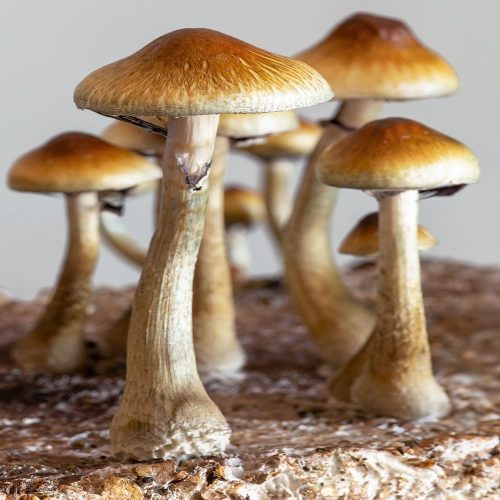
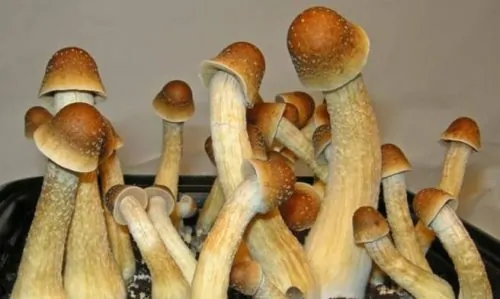
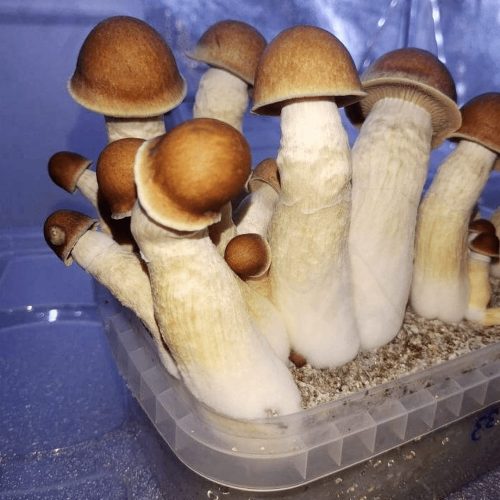
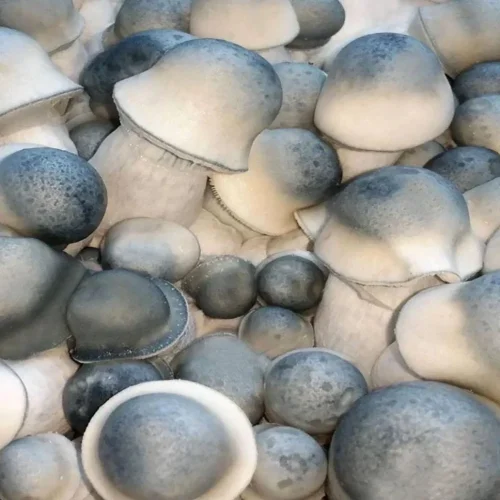
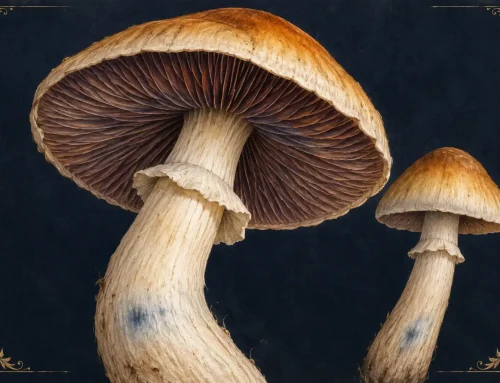
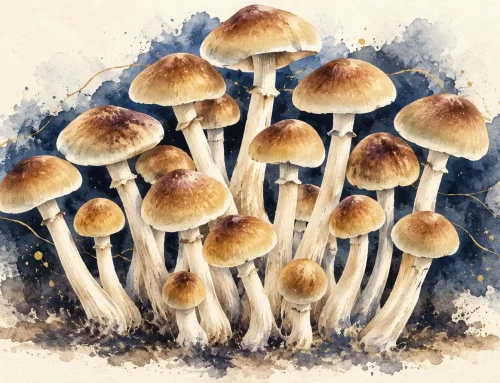
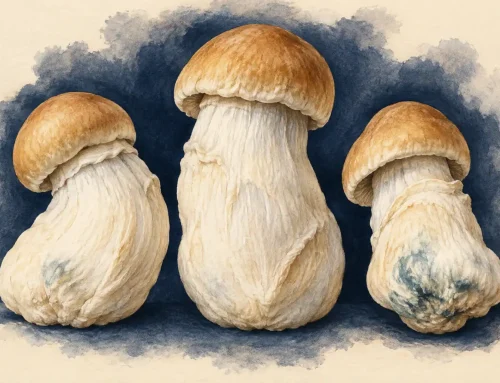
The familiar Golden Teacher appearance combines a warm-colored cap with a pale stem and darker gills beneath. Shape, color, and proportions change as a mushroom develops, so a single photograph captures only one stage of its appearance.
Caps: golden, caramel, and changing with maturity
Golden Teacher is commonly described as having golden-yellow to caramel-brown caps. Younger caps tend to look more rounded; mature caps can spread into a broader profile. A darker or slightly raised center may remain visible. These features contribute to its recognizable appearance, but none is exclusive to Golden Teacher.
Stems, gills, and the ring
In P. cubensis, the stem is generally pale, with a fibrous surface. A membranous ring, called an annulus, can remain around the upper stem. Beneath the cap, closely spaced gills become dark as the mushroom matures and spores accumulate. Species descriptions record purplish-gray gills and spores that appear purplish brown in a prepared mount. [3]
The ring is the remnant of a protective partial veil. It belongs to the mushroom’s developmental anatomy, while the dark material deposited around it can include spores. This explains why the same mushroom can show a pale stem, a darker ring, and still darker gills without those colors being interchangeable identification features.
Why can the tissue bruise blue?
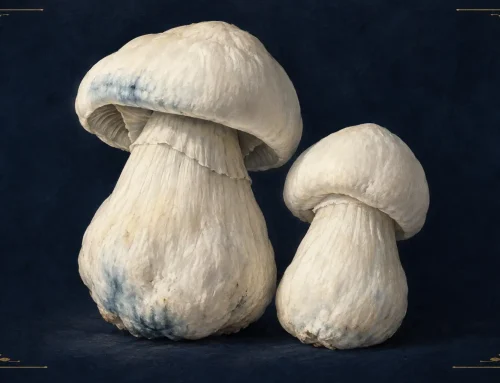
The blue staining associated with P. cubensis involves a chemical reaction following tissue injury. Researchers identified an enzyme-driven sequence involving psilocybin and the oxidative coupling of psilocin-derived units into colored products. The blue color is therefore more complicated than “psilocybin is blue.” [4]
Bruising is not a potency meter. A darker blue patch does not provide a measured alkaloid concentration, and blue staining alone does not establish that an unknown mushroom is safe to consume. Golden caps, dark gills, and a ring also occur in other mushrooms. This profile is a description of known material, not a wild-mushroom identification checklist.
The broader ecological background
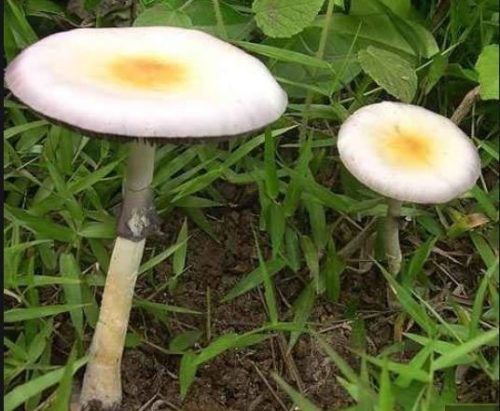
P. cubensis is a decomposer associated with dung and disturbed, grassy environments in tropical and subtropical regions. These species-level associations explain its ecological background; they do not prove where Golden Teacher originated. A wild mushroom resembling Golden Teacher cannot be assigned that commercial lineage from habitat or appearance alone. [3]
Golden Teacher Effects: Reputation and What the Evidence Supports
Golden Teacher is often described in personal accounts as introspective, emotionally engaging, or “teaching.” Those descriptions help explain its reputation. They do not establish a unique, predictable effect profile that reliably separates it from every other P. cubensis variety.
How psilocybin produces psychedelic effects
The body converts psilocybin into psilocin, which acts on serotonin receptors, particularly 5-HT2A. The resulting changes can affect perception, emotion, thought, and the sense of self. NIDA describes experiences ranging from altered sights and sounds to changes in the perception of time and space. [5]
Reported effects may include more vivid colors, unusual patterns, intensified emotions, and a feeling that familiar thoughts have taken on new significance. Experiences can also involve fear, confusion, panic, nausea, and increased heart rate or blood pressure. Positive descriptions do not cancel out those possibilities.
Expectations, surroundings, individual biology, and the actual chemical content of the material all matter. “Golden Teacher” on a label cannot account for those variables. Its reputation for being approachable should not be interpreted as a guarantee of a mild or comfortable experience.
Are Golden Teacher mushrooms strong?
“Moderate potency” is a common informal description, including in our earlier article. The difficulty is that moderate has no standard laboratory definition for a named variety. A mushroom name is not a test result.
A 2025 study using quantitative nuclear magnetic resonance included a sample labeled Golden Teacher and measured its psilocybin and psilocin content. The study also found variation among the materials examined. One tested sample provides information about that sample; it cannot establish a universal Golden Teacher percentage. [6]
Other analytical work has documented variability and instability in psilocybin-related compounds across mushroom specimens. This makes simple rankings—especially rankings without sample details or laboratory methods—less informative than they appear. Claims that Golden Teacher is always weaker, stronger, gentler, or more visual than another variety go beyond what a name alone can support. [7]
What about therapeutic potential?
Clinical interest in psilocybin includes depression, alcohol use disorder, and distress associated with serious illness. Some studies have reported promising outcomes when psilocybin was combined with structured psychological support. These findings concern specific study conditions, screened participants, and defined treatments; they do not demonstrate that Golden Teacher mushrooms or Golden Teacher spores treat those conditions. [8]
That distinction preserves what is interesting about the science without turning a mushroom profile into a treatment claim. A clinical finding about psilocybin is not automatically evidence for a particular commercial variety, an unsupervised experience, or a spore product.
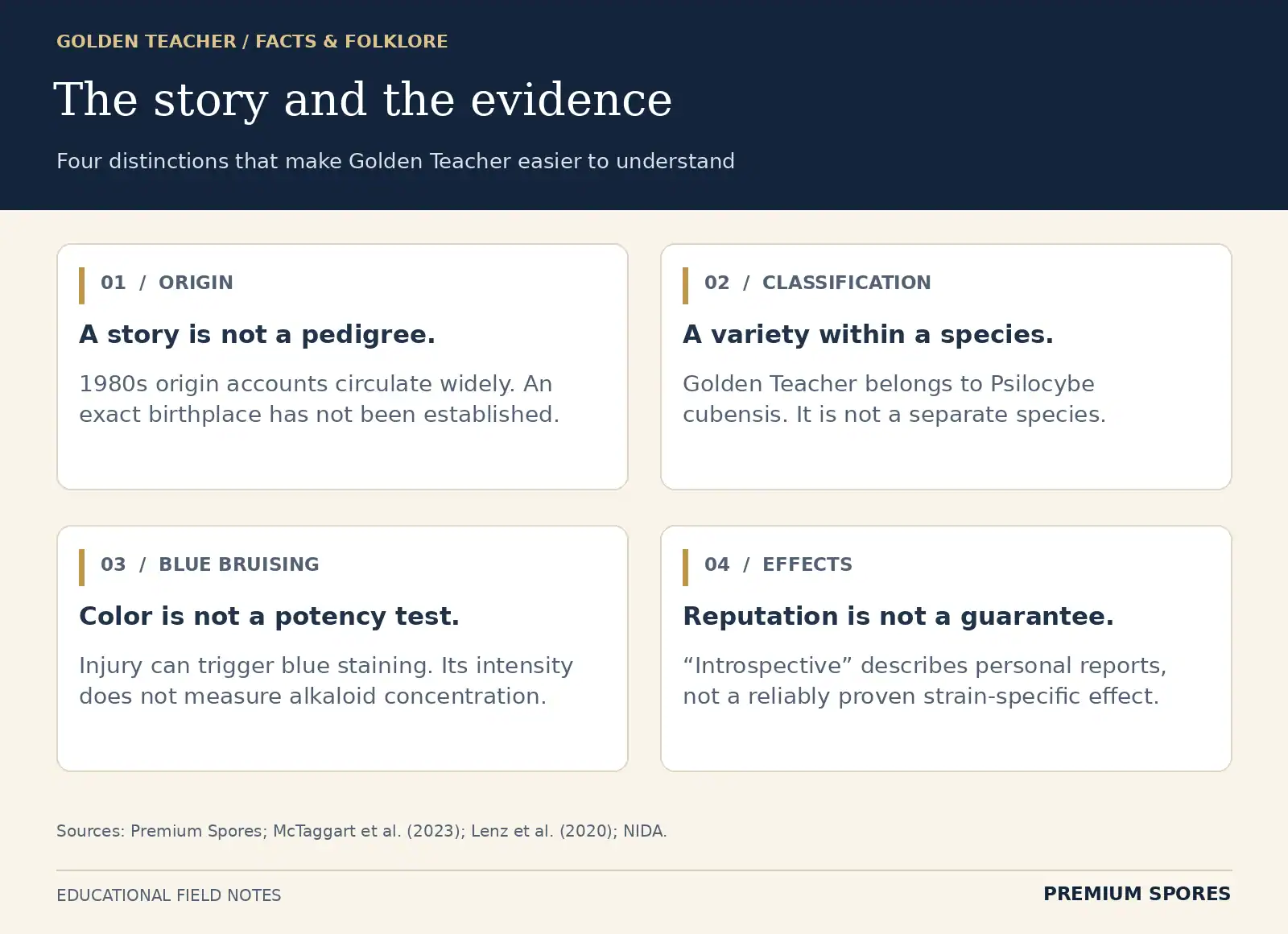 Golden Teacher’s reputation is interesting; keeping it separate from measured evidence makes the story more useful.
Golden Teacher Spores: Color, Shape, Size, and Structure
Golden Teacher spores carry the name of the lineage from which they were obtained, but their visible features largely follow the broader P. cubensis pattern. The most useful description combines color, outline, dimensions, surface structure, and the presence of a germ pore.
Spore color: purple-brown rather than gold
The golden mushroom cap does not produce golden spores. Golden Teacher spore deposits are generally described as deep purplish brown to purple-black. A dense deposit can appear nearly black, while individual spores viewed with transmitted light may appear brown. Deposit thickness and viewing conditions help explain why descriptions use somewhat different color terms.
Shape and surface
Published descriptions of P. cubensis spores include ellipsoid to somewhat angular outlines, a smooth surface, and a conspicuous germ pore. “Ellipsoid” describes a three-dimensional oval form. The outline in a two-dimensional view can change with orientation, which is one reason a sample should not be represented by a single idealized oval. [3]
How large are Golden Teacher spores?
Spore dimensions are measured in micrometers, written µm. One micrometer is one-thousandth of a millimeter, so these are structures far smaller than the mushroom’s visible parts.
As a published comparison, Tsujikawa and colleagues reported 10.2–16.5 µm long by 5.9–10.0 µm wide for the material they described as P. cubensis. This was not a Golden Teacher-specific study or a product specification; the authors also noted difficulty separating closely similar material. The range is useful context, not a pass-or-fail standard for every Golden Teacher sample. [9]
What is the germ pore?
A germ pore is a specialized region of the spore wall associated with the emergence of a germ tube. “Apical” means it is located at an end of the spore. The same published study described a distinct apical pore and a smooth spore surface. These structural features help describe the sample, but they are not unique signatures of Golden Teacher. [9]
| Characteristic | What it describes | What it does not establish |
|---|---|---|
| Deposit color | Dark purplish-brown to purple-black material | A unique Golden Teacher identity |
| Spore outline | Oval to somewhat angular forms, depending on view | A mushroom’s eventual size or shape |
| Dimensions | The measured size of sampled spores | A universal measurement for the lineage |
| Smooth surface and pore | Structural features used in description | Potency or a specific subjective effect |
| Label and provenance | The documented source of the material | Independent confirmation from appearance alone |
 Golden Teacher spores share core structural traits with other members of Psilocybe cubensis. See the text and references for measurement context.
Can spores alone confirm the Golden Teacher name?
No ordinary visual feature described here is a Golden Teacher barcode. The shape and pigmentation of a spore can be consistent with an identification without proving a specific commercial lineage. Provenance matters because a label carries information that a photograph does not.
This is also why comparison images should be interpreted cautiously. Different lighting, enlargement, or preparation can make similar spores look different. Conversely, similar-looking spores do not necessarily come from identical genetic material. Genetic research and specimen authentication address different questions from a simple visual comparison. [7]
What Does “Multispore Golden Teacher” Mean?
A multispore syringe contains a suspension of spores from the named lineage. “Multi” describes the presence of many spores; it does not mean the syringe is a blend of several named varieties.
It also should not be read as “many identical copies.” Spores arise through sexual reproduction and can carry genetic variation. A multispore label therefore does not promise one fixed genotype, one uniform mushroom appearance, or a particular chemical profile.
For the standard format, see the Golden Teacher Spore Syringe from Premium Spores. Keeping the product name and the biological description separate makes it easier to understand exactly what the listing represents.
Why Are Golden Teacher Mushrooms and its Spores So Popular?
Golden Teacher has several qualities that help explain its staying power. None requires treating every story about it as established fact.
A memorable visual identity
A golden cap above a pale stem is an easy image to remember. The name gives that appearance a simple verbal counterpart. Someone encountering mushroom varieties for the first time can connect the words to the picture without needing a long technical explanation.
A story that invites curiosity
The “teacher” association creates an immediate question: what are people describing when they say a mushroom taught them something? That question opens a conversation about perception, memory, expectations, and the language people use for unusual experiences. It remains interesting even when the accounts are treated as personal testimony.
An accessible introduction to mushroom biology
Golden Teacher gives readers a concrete way to connect a cap and gills with tiny reproductive cells, then connect those visible features with larger questions about taxonomy and genetics. It is easier to understand the difference between a species and a strain when both names refer to something recognizable.
Familiarity that reinforces familiarity
Being discussed across catalogs, articles, and community conversations makes a name easier to encounter again. Recognition encourages more questions and comparisons. Popularity can therefore tell us something about cultural reach without proving superiority, exceptional safety, or a unique effect.
Golden Teacher Mushroom and Spore FAQs
Are Golden Teacher mushrooms the same as Psilocybe cubensis?
Golden Teacher belongs to P. cubensis. The species includes other named varieties, so the terms are related but not interchangeable. Golden Teacher is the more specific commercial or community designation.
Are Golden Teacher spores gold?
No. The name refers to the mushroom cap. The spore deposit is dark, generally purplish brown to purple-black, rather than gold.
Does “multispore” mean multiple strains?
No. It means many spores. A Golden Teacher multispore product is labeled for that lineage, rather than a mixture of several named varieties.
Does blue bruising show how strong a mushroom is?
No. Bruising is a visible chemical reaction, not a quantitative potency test. It also cannot independently establish that an unknown mushroom is safe.
Is Golden Teacher proven to create a more introspective experience?
The introspective reputation comes from personal accounts and community descriptions. The evidence reviewed for this article does not establish a predictable Golden Teacher-specific psychological effect.
Can you identify Golden Teacher from a spore photograph?
A photograph may illustrate useful spore features, but the overlapping traits of P. cubensis varieties prevent it from independently proving the Golden Teacher name.
Where can I find Golden Teacher spores?
Premium Spores offers a low priced Golden Teacher multispore syringe. You can also browse the Psilocybin Mushroom Spores collection to explore other named varieties.
Sources and Further Reading
This guide expands on Premium Spores’ Golden Teacher article on Medium. Historical anecdotes and commercial descriptions are distinguished from taxonomic, chemical, and clinical evidence.
- Catalogue of Fungi of Colombia / Kew. Psilocybe cubensis species description.
- Lenz et al. (2020). Injury-Triggered Blueing Reactions of Psilocybe “Magic” Mushrooms. Angewandte Chemie International Edition.
- National Institute on Drug Abuse. Psilocybin (Magic Mushrooms).
- Rodríguez et al. (2025). Novel qNMR Method to Quantify Psilocybin and Psilocin in Psychedelic Mushrooms. ACS Omega.
- Bradshaw et al. (2022). DNA Authentication and Chemical Analysis of Psilocybe Mushrooms Reveal Widespread Misdeterminations in Fungaria and Inconsistencies in Metabolites. Applied and Environmental Microbiology.
- National Center for Complementary and Integrative Health. Psilocybin for Mental Health and Addiction: What You Need To Know.
- Tsujikawa et al. (2003). Morphological and chemical analysis of magic mushrooms in Japan. Forensic Science International. Measurement context is species-level material, not verified Golden Teacher specimens.
Educational purposes only. This article is not medical advice or a guide to identifying wild mushrooms for consumption. It does not encourage cultivation, possession, or use where prohibited. Premium Spores’ Golden Teacher spore products are intended for microscopy and taxonomy only, not consumption or cultivation. Follow applicable laws.