Purple Mystic Mushroom Strain Guide: Florida Origins, Traits and Spores
The name Purple Mystic might bring a violet mushroom to mind. The real appearance is more subtle: warm tan caps, pale stems, and dark accents that become interesting when you look a little closer. Its story begins with a Florida connection and continues through the curiosity of a community that shared photographs, observations, and specimens.
Among familiar cubensis names, Purple Mystic offers a different kind of appeal. There is no need for an elaborate legend to make it interesting. Its recorded community history, classic mushroom proportions, and connection between cap color and spore color give us plenty to explore.
At Premium Spores, we appreciate varieties that invite a second look. This guide follows Purple Mystic from its reported origins to its visible features and the microscopic spores behind the name.
What Are Purple Mystic Mushrooms?
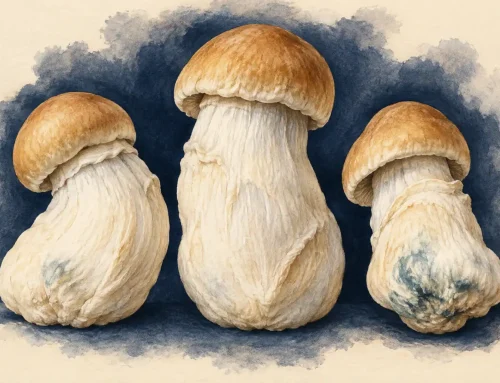
Purple Mystic is a named variety of Psilocybe cubensis, often abbreviated PM in community discussions. It belongs to the same species as Golden Teacher and Penis Envy, although the familiar Purple Mystic appearance is closer to a conventional cap-and-stem silhouette than the compact PE form.
The species name and the variety name serve different purposes. Psilocybe cubensis places the fungus in a biological classification. Purple Mystic identifies the named material being discussed. A variety can have a recognizable history without every specimen being identical in shape, color, or chemical composition.
Our Purple Mystic Mushroom Spore Syringe page describes the variety’s warm-colored caps, pale stems, and purplish-brown spore characteristics. Those features provide a starting point for comparison, rather than a guarantee that every photograph will look the same.
The Florida Connection: A Community History We Can Trace
A useful early account appears in a Shroomery discussion started on April 15, 2014, by the participant Blackd0ve420. The author associated Purple Mystic with Plant City, Florida, described collecting the wild mushrooms from 2008 onward, and recorded the later distribution of prints within the community. Replies contributed recollections about the material’s circulation. [1]
This gives the story a dated reference and a named participant, rather than relying entirely on recent catalog descriptions. It remains a firsthand community account, however—not an independently authenticated ancestry record for every modern specimen carrying the name.
The distinction also helps explain why an early collection date and a later introduction date may both appear in discussions. Finding material, sharing it, and publishing its history are separate events. A useful description says which event a date refers to.
The Florida association fits the broader ecological background of P. cubensis. Taxonomic descriptions associate the species with dung, meadows, and disturbed tropical vegetation. That species-level context supports understanding the habitat; it does not independently verify Purple Mystic’s particular collection history. [2]
What Do Purple Mystic Mushrooms Look Like?
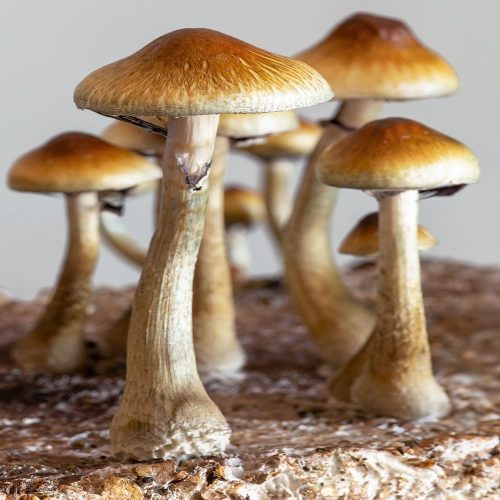
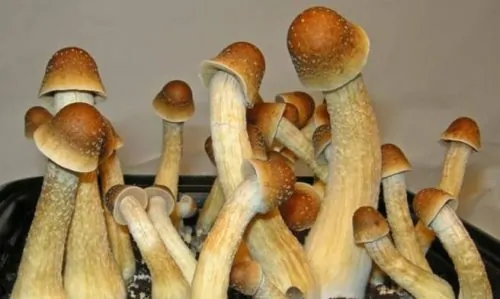
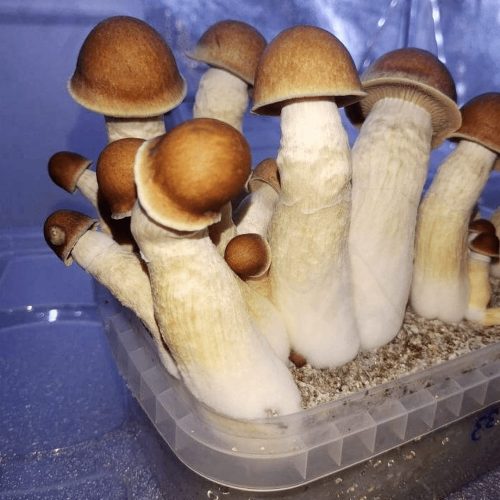
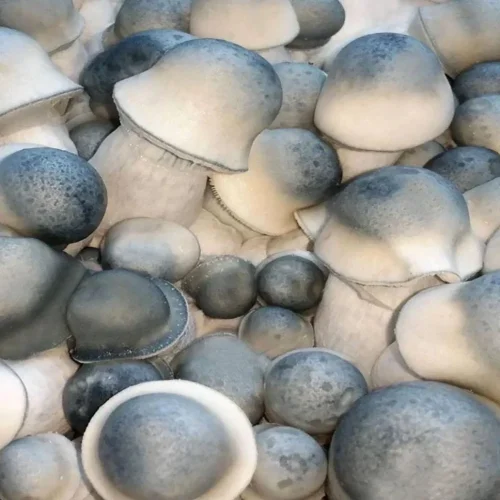
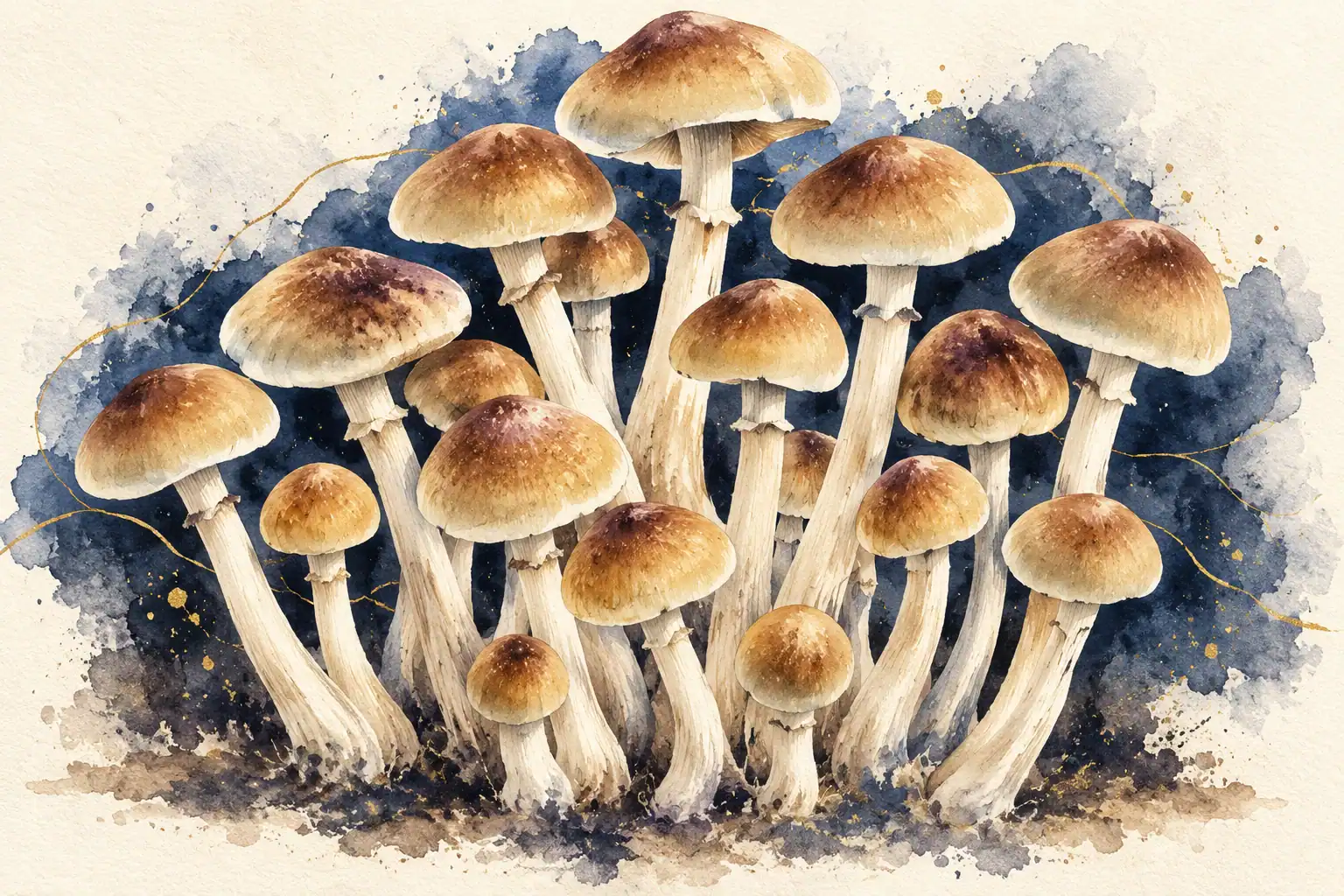
The reference photograph behind our illustration shows a crowded arrangement of pale stems and warm, rounded caps at different heights. Some caps have darker centers, others lighter edges, and a few carry deeper surface markings. That mix creates a more natural picture than one perfectly uniform mushroom repeated across a frame.
Caps with warm centers and lighter edges
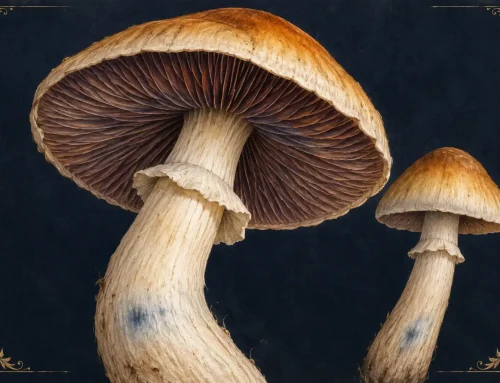
Purple Mystic caps are commonly described in shades of tan, golden brown, caramel, or chestnut. The center can appear darker than the margin. Younger-looking caps often have a rounded outline; broader examples display a more open profile.
The cap is also a surface that catches light. A highlight can make its edge look nearly cream-colored, while overlapping mushrooms create shadows that deepen the apparent color. A photograph records all of those conditions together.
Pale stems and familiar mushroom proportions
The stems in the supplied reference are relatively tall and slender, with white-to-cream surfaces. Several show a ring beneath the cap. A ring, also called an annulus, is associated with the partial veil that covered the developing gills.
These proportions give Purple Mystic a different visual rhythm from the thick, compact forms discussed in our Penis Envy mushrooms and spores guide. It is a useful descriptive comparison, not a method for identifying an unknown specimen.
Is Purple Mystic Actually Purple?
Not in the bright, uniformly purple sense the name might suggest. Our Purple Mystic profile associates the name with darker purplish coloration and mature spore deposits, while describing the caps themselves in warm brown tones. A useful way to understand the appearance is to separate three sources of color.
| What you notice | What it describes | Why the distinction matters |
|---|---|---|
| Tan or caramel cap | The visible appearance of the cap surface | Lighting and maturity influence the impression |
| Dark purple-brown deposit | Accumulated spores, where confirmed | A deposit is material on a surface, not necessarily the tissue’s own pigmentation |
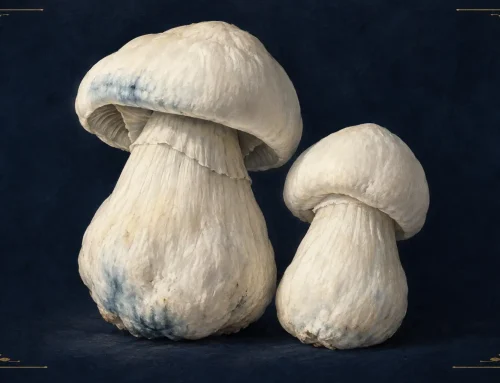
| Blue or blue-green tissue | Possible injury-related staining | Bruising is a separate chemical phenomenon |
Researchers studying blueing in P. cubensis identified an enzyme-driven sequence involving psilocybin and the formation of colored products from psilocin-derived units. That explains why a bruise and a dark spore deposit should not be treated as the same feature. [3]
A photograph alone may not tell you which process caused a particular dark patch. It also cannot turn color intensity into a potency measurement. The appeal of those markings is visual; their interpretation requires more context.
Purple Mystic Spores: The Smaller Side of the Story
Purple Mystic spores are reproductive cells associated with material labeled for this cubensis variety. The mushroom is the visible fruiting body; its spores are structures examined at a much smaller scale.
Published descriptions of P. cubensis include smooth spores with oval-to-somewhat-angular outlines and a conspicuous germ pore. The Catalogue of Fungi of Colombia describes purplish-brown spores in a prepared mount and a dark spore print. These are species-level reference features, not a Purple Mystic-specific measurement study. [2]
Why a spore deposit can look darker than individual spores
A visible deposit contains many overlapping cells. Under a microscope, light may pass through individual spores instead. The difference in concentration and viewing conditions helps explain why one description says brown, another says purple-brown, and a dense deposit can appear almost black.
What does “multispore” mean?
A multispore syringe contains many spores in suspension. It does not inherently mean several named varieties have been mixed together. The term describes the specimen format, while Purple Mystic records the variety designation.
Premium Spores offers both a Purple Mystic multispore syringe and an Isolated Purple Mystic Spore Syringe. Consult each listing for its specific description and included materials. A product label should be read alongside the actual specimen information, especially when comparing formats.
For background, our guide to psilocybin mushroom spores introduces the connection between the mushroom and its reproductive cells.
What Is Known About Purple Mystic’s Reputation?
Purple Mystic attracts descriptions of unusual strength and distinctive experiences. The sources reviewed for this guide did not establish a controlled Purple Mystic-specific effect profile or a universal potency level. That leaves room to discuss its reputation without presenting it as a measured property of every specimen.
Broader research on Psilocybe has documented identification problems and variability in chemical measurements. Those findings provide useful context for evaluating claims, but they should not be presented as laboratory tests of Purple Mystic or of Premium Spores products. [4]
That is what makes this variety a worthwhile subject: a name that raises a question, a historical account we can examine, and visible features that lead naturally into mushroom biology. For a comparison with another familiar cubensis name, explore our Golden Teacher mushrooms and spores guide.
Purple Mystic Mushroom and Spore FAQs
Where is Purple Mystic reported to come from?
An early community account associates it with Plant City, Florida. That is a reported collection history, rather than independent verification of every modern specimen’s ancestry.
Are Purple Mystic mushrooms completely purple?
No. They are commonly described with tan-to-caramel caps and pale stems. Dark purplish markings or deposits are different from an entirely purple cap.
Are Purple Mystic spores a different species from Golden Teacher spores?
No. Both names refer to varieties within Psilocybe cubensis. The variety designations distinguish named material within that species.
Does a dark spore deposit prove the Purple Mystic name?
No. Dark spores occur in other cubensis material. Color alone cannot authenticate a commercial variety designation.
Where can I find Purple Mystic spores from Premium Spores?
See our Purple Mystic Mushroom Spore Syringe or Isolated Purple Mystic Spore Syringe listings for the current product details.
Sources and Further Reading
- Blackd0ve420 (2014). History of the Purple Mystic: A Working Historical Thread of the PM. Firsthand community history; not peer-reviewed evidence of potency or therapeutic effects.
- Catalogue of Fungi of Colombia / Kew. Psilocybe cubensis species description. Species-level morphology and ecology.
- Lenz et al. (2020). Injury-Triggered Blueing Reactions of Psilocybe “Magic” Mushrooms. Angewandte Chemie International Edition.
- Bradshaw et al. (2022). DNA Authentication and Chemical Analysis of Psilocybe Mushrooms Reveal Widespread Misdeterminations in Fungaria and Inconsistencies in Metabolites. Applied and Environmental Microbiology.
Educational purposes only. This article is not medical advice or a guide to identifying wild mushrooms for consumption. Premium Spores specimens are intended for lawful microscopy and taxonomy research, not consumption or cultivation.