The History Of B+ Mushrooms and Spores
B+ cubensis mushrooms have a familiar silhouette: warm caramel caps, pale stems, and the broad, open shape many people picture when they hear the name Psilocybe cubensis. B+ was actually the first variety we began selling at Premium Spores, so it has a special place in our collection.
Often written as B-Plus, B+ is a named variety within P. cubensis. Its story offers a useful way to separate visible mushroom traits, the history attached to a variety name, and the reproductive cells examined under a microscope. This guide looks at B+ mushrooms and spores, their commonly repeated origin story, their relationship to Golden Teacher, and what published research can actually tell us about their chemistry.
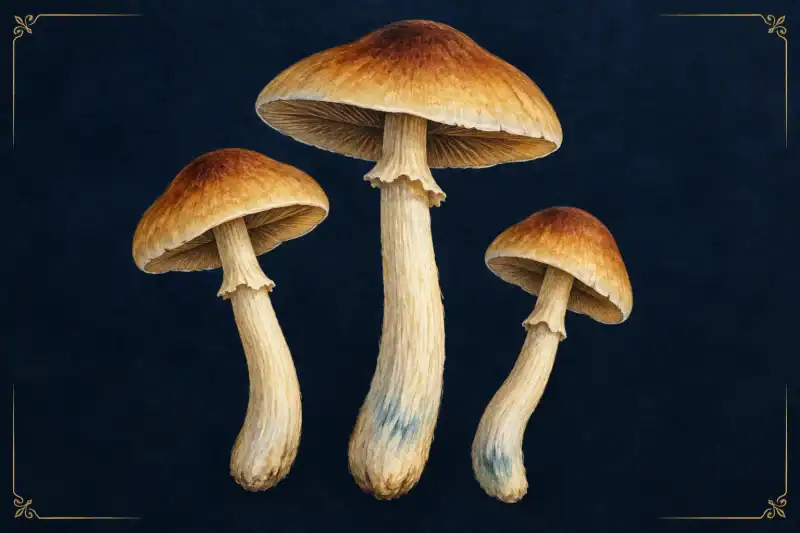
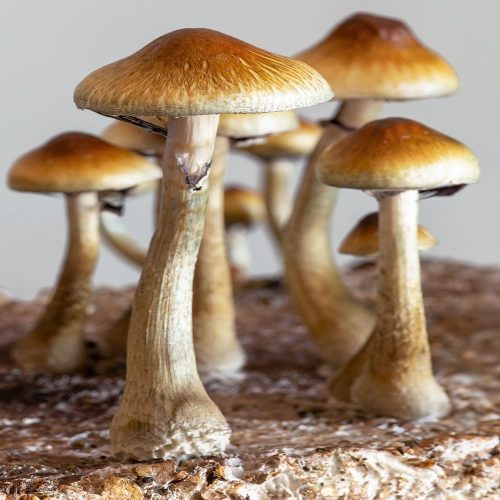
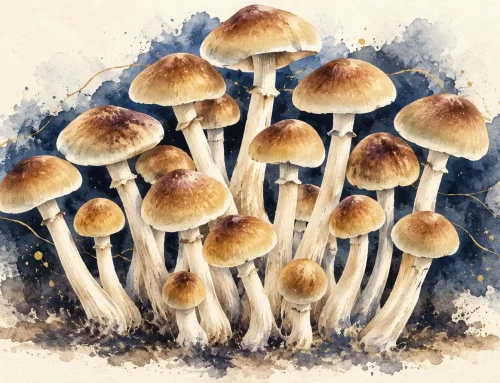
Illustration of B+ cubensis mushrooms
In this article
What Are B+ Cubensis Mushrooms?
B+ is the name of the variety of this Psilocybe cubensis mushroom. Golden Teacher and Penis Envy, Purple Mystic are names of other varieties of the Psiloycbe cubensis mushroom species. A 2025 study that examined fungal DNA and chemical profiles listed both B+ and Golden Teacher as P. cubensis samples.[1]
B+ Origins: A Familiar Story With an Incomplete Record
The most repeated B+ origin story credits a cultivator known as “Mr. G” and places the variety’s development in Florida in the 1990s. He selected and stabalized B+ for its large size and hardiness.
The uncertainty of its exact origin does not erase the variety’s long-standing place in microscopy research. In a 2025 research collection, a B+ sample was identified as P. cubensis using an internal transcribed spacer (ITS) DNA sequence; that finding identifies the sampled species, not the historical origin of every B+ line.[1]
Caps, Stems, Gills, and Blue Bruising
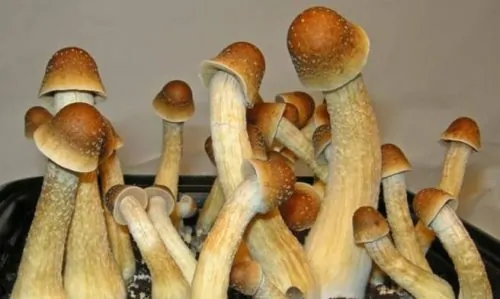
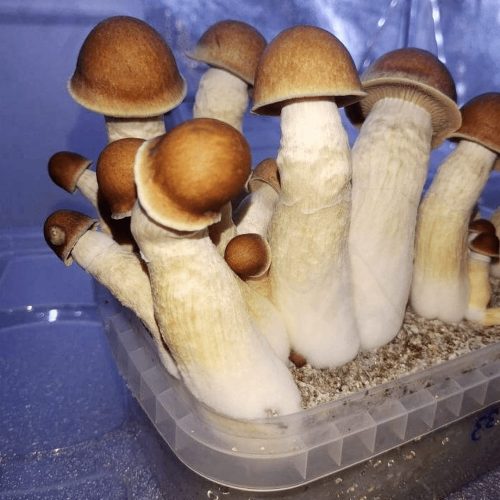
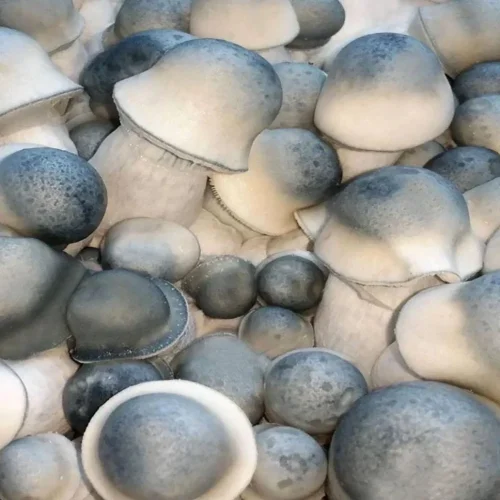
Images commonly associated with B+ show a tan to caramel cap that can flatten and become paler as it matures. The stem is generally pale and may show blue discoloration where tissue is damaged. As with other P. cubensis varieties, the gills darken as spores mature and a dense spore deposit appears dark purplish brown.
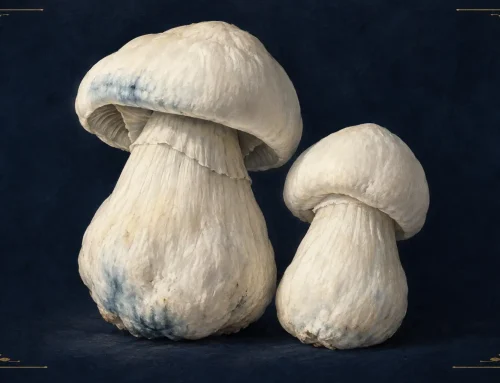
These are broad descriptions of the species and of material labeled B+. Color and shape can vary among individual specimens, stages of development, and photographs. Blue bruising may be visually striking, but it is not a laboratory measurement of psilocybin or a reliable way to rank varieties by potency.
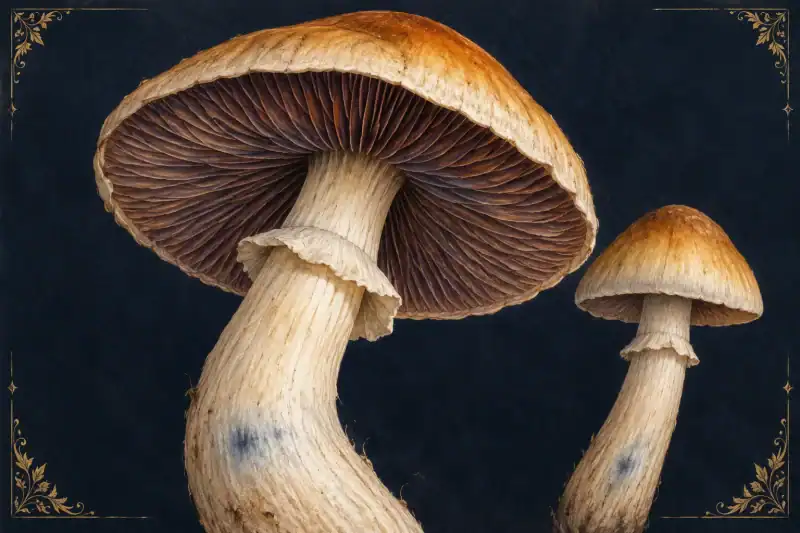
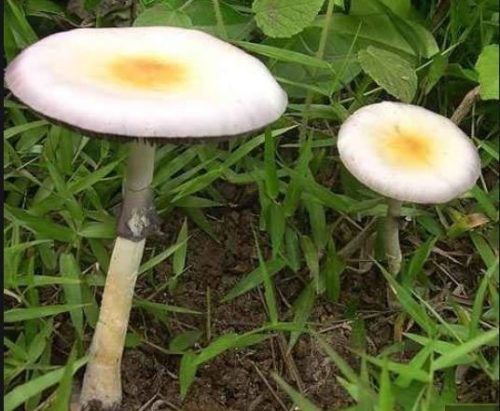
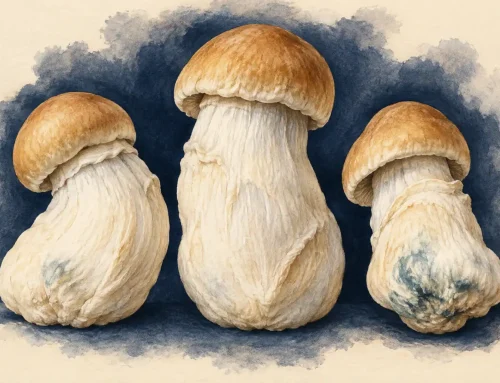
A closeup of B+ mushrooms (illustration).
B+ Versus Golden Teacher
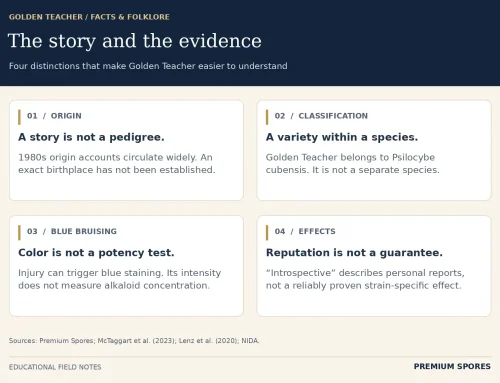
B+ and Golden Teacher are both names P. cubensis varieties. While we’d argue that Penis Envy has overtaken B+ as the second most popular variety, B+ remains extremely popular among microscopy researchers. Golden Teacher and B+ look extremely similar. Their golden-brown caps can overlap considerably in appearance. The comparison below describes common catalog language; it should not be used to identify an unknown mushroom or predict the chemical composition of an individual specimen.
Two familiar variety names within Psilocybe cubensis
| Feature | B+ | Golden Teacher |
|---|---|---|
| Species | Psilocybe cubensis | Psilocybe cubensis |
| Familiar visual description | Caramel to tan cap and pale stem | Golden-brown cap and pale stem |
| Dense spore deposit | Dark purplish brown | Dark purplish brown |
| What the name establishes | A named B+ lineage or catalog label | A named Golden Teacher lineage or catalog label |
For more on the other variety, see our Golden Teacher mushroom and spore guide.
Potency and Published Research
In a 2024 analytical study, researchers used liquid chromatography and tandem mass spectrometry to measure psilocybin and psilocin in five labeled P. cubensis varieties. The B-Plus sample averaged 1.134% combined psilocybin and psilocin by dry weight across three individual mushrooms. Within that small set, B+ ranked below Creeper and Blue Meanie and above Texas Yellow and Thai Cubensis.[2]
That number describes the specific analyzed samples, not a universal B+ potency. The authors measured differences among mushrooms bearing the same label and found that homogenizing multiple mushrooms improved measurement precision in a second laboratory. It would be misleading to turn a three-mushroom average into a promise about every B+ specimen or spore sample.
A separate 2025 analysis of 42 fungal strains included B+ and Golden Teacher among its P. cubensis samples. The researchers examined broader metabolite profiles and used DNA identification alongside morphology, illustrating why a variety name alone is a limited substitute for measured evidence.[1] Spore microscopy does not measure the chemistry of fruiting bodies.
B+ Spores and Microscopy
Spores are microscopic reproductive cells, distinct from the mushroom’s cap, gills, and stem. A dense P. cubensis spore deposit typically appears dark purplish brown. Under a microscope, species-level descriptions note smooth-walled, broadly ellipsoid spores with a germ pore. The appearance of a particular slide depends on preparation, lighting, focus, and which spores happen to be in view.
Microscopy can document shape, color, and other visible structures. It cannot verify a precise origin story or establish the potency of a future mushroom. A B+ label is useful context for a collection, but a single spore viewed under a microscope is not a unique visual fingerprint for that variety.
At Premium Spores, B+ spore material is offered for lawful microscopy and taxonomic study only. For a broader explanation of formats, see our isolated versus multispore syringe guide.
Frequently Asked Questions About B+
Is B+ a separate species?
No. As we discussed above, B+ is a named variety within Psilocybe cubensis, not a separately described species.[1]
Is B+ the same as Golden Teacher?
No. They are distinct names used for material within the same species. Their visible traits may overlap, and neither name alone determines the chemistry of an individual specimen.
Can you identify B+ spores by sight alone?
Microscopy can show features consistent with P. cubensis, but the variety name cannot be reliably authenticated from the look of one spore alone.
Does blue bruising prove that a B+ specimen is stronger?
Probably not. Bruising is a visible reaction in damaged tissue, not a quantitative chemical test. Potency claims require analysis of a particular sample.
What does the published B+ potency figure mean?
The 1.134% combined value reported in the 2024 study is an average for three dried mushrooms in that study. It is not a standard value for every B+ specimen.[2]
A Familiar Name, With Room for Careful Observation
B+ remains a recognizable name in the P. cubensis world and an important part of Premium Spores’ own history. Its appeal as a subject of study lies in the details: how a name is used, how a specimen is documented, what can be observed under a microscope, and where the evidence ends. Good records and careful wording make those differences clearer.
Sources and Further Reading
- Comprehensive analysis of 42 psilocybin-producing fungal strains reveals metabolite diversity and species-specific clusters, 2025. Includes B+ and Golden Teacher samples and ITS identification.
- Goff et al., “Determination of psilocybin and psilocin content in multiple Psilocybe cubensis mushroom strains using liquid chromatography–tandem mass spectrometry,” Analytica Chimica Acta, 2024.